 Andrew
General educational commentary only, generated automatically with AI. Not investment advice or a recommendation to buy, sell or hold any security. Capital is at risk.
Indexes Diverge While Traders Wait for Catalysts
U.S. stocks closed mixed on Monday, according to the news brief. The S&P 500 slipped 0.05% to 7,807.79. The Dow rose 0.38%, and Invezz reported the Dow closed 198 points higher. The brief said trading was subdued as investors waited for bank results, inflation data and the Fed's next move. The bull market has gained about 118% since its October 2022 low, per the brief. CNBC noted the bull market turned four years old on Monday, and some investors say a fifth year could be hard.
Earnings Bar Sits High before Bank Reports
Third-quarter earnings expectations are elevated, the brief said. Barron's described Wall Street as unusually optimistic, with technology and energy profits supporting forecasts. Positive company guidance also helped. The brief said the reports will test whether that optimism is justified. Major-bank earnings were due Tuesday, and the U.S. CPI report was due Wednesday. Fed officials were also in focus. Cleveland Fed President Beth Hammack said restrictive policy may be needed to contain inflation, Reuters reported. That keeps rate-hike risk in view.
Oil Supply Risks Remain despite Diesel Talk
Oil eased on hopes Russia could send more diesel to global markets. Reuters said Russia discussed exports of up to 3.5 million tons a month by year-end. The brief said that supply is unlikely to resolve the shortage. Estimates put the global diesel deficit near 1 million barrels a day. Reuters also said shipping and insurance costs for energy flows are rising. Attacks tied to the Saudi-Houthi conflict keep supply risks elevated. The IMF expects global growth to slow to 3.1% in 2026, CNBC reported. That is better than its prior forecast. AI investment and fiscal support may cushion the impact of conflict. The IMF also projects inflation rising to 4.7%.
Overseas Memory Selling Dominates Online Posts
Online sentiment comes from unverified posts by anonymous retail users. It may include rumour or speculation and has not been checked. In those posts, the dominant theme was a sharp fall in Korean equities. Posts said the KOSPI fell more than 6% and broke below 6000, with large memory names down about 8%. Posts also claimed a circuit breaker or sidecar was triggered, but no confirming report was found. The same posts described further weakness in U.S. memory and semiconductor shares overnight. Some users called the move "a repeat of July" and compared it to a past shock. Others said the panic was sector-specific. They noted that broad U.S. index funds barely moved, while memory and leveraged instruments fell hard. Fear readings in those posts were near 20/100 for memory and semiconductors and near 35/100 overall. Posts included capitulation talk and also dip-buying talk. None of this is confirmed positioning or institutional flow.
One Screen Flags Dow Weakness on Several Measures
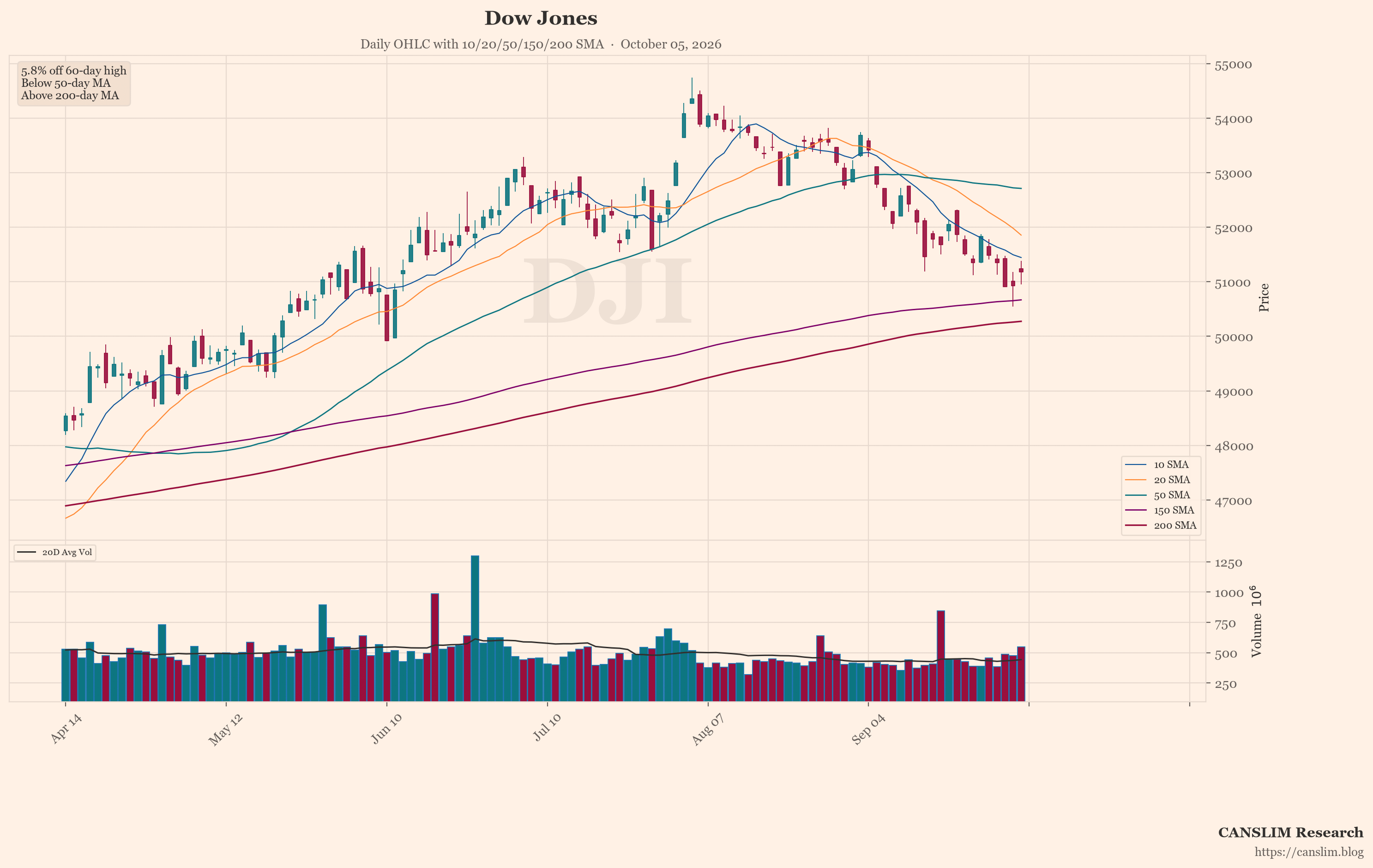
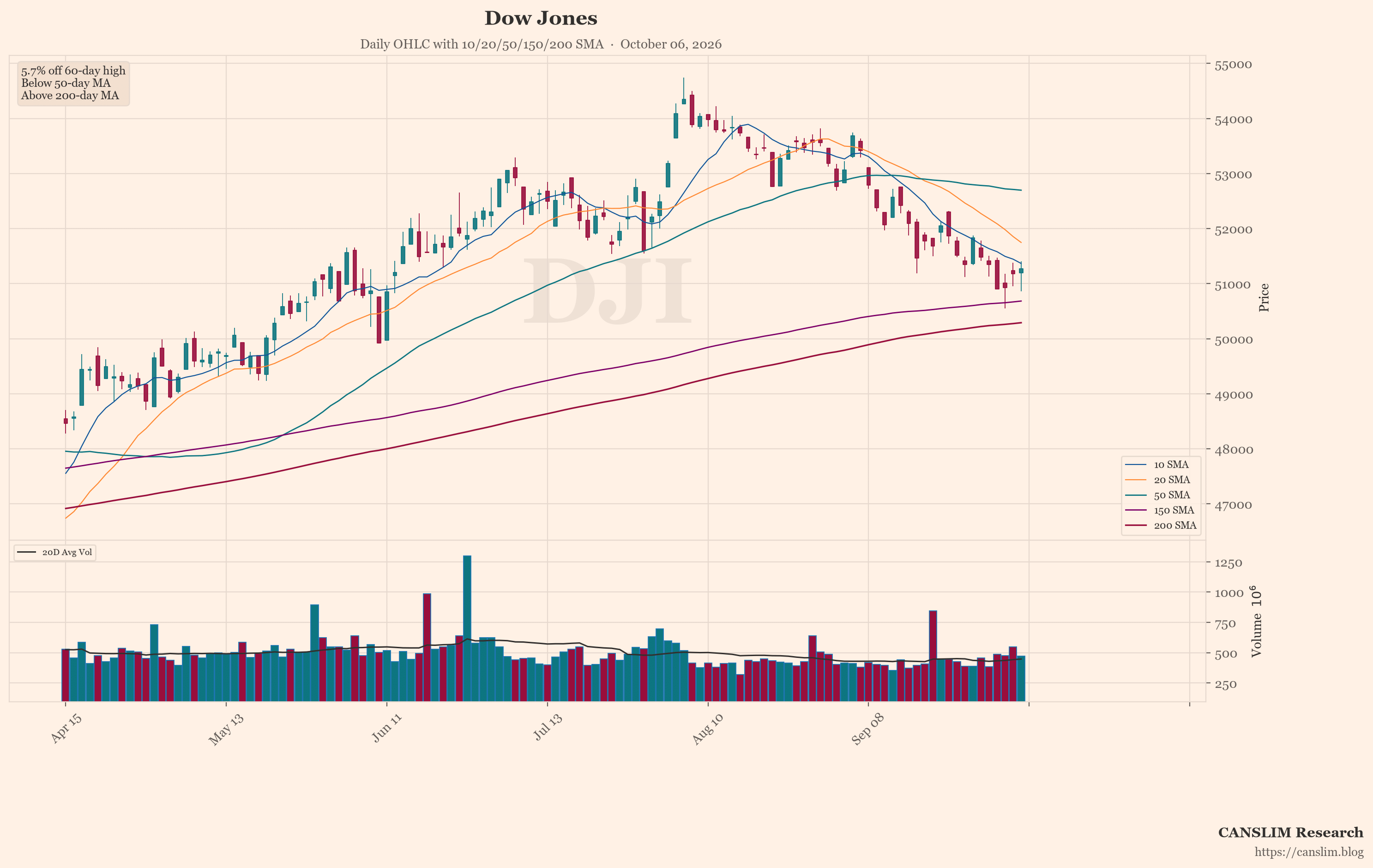
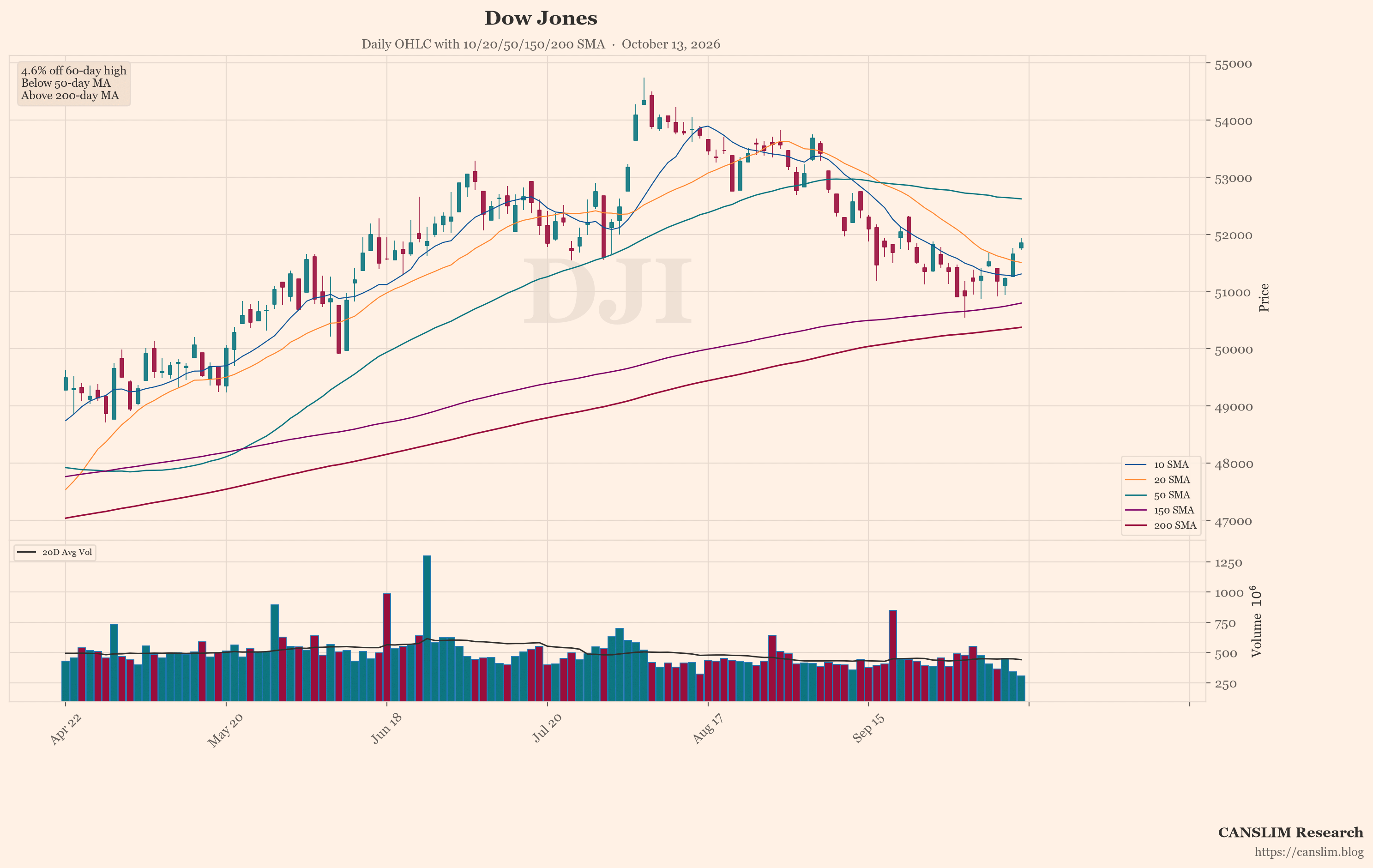
The featured chart shows the Dow Jones (^DJI). An automated technical screen picked it because, among the indices and stocks it checked, it showed the most weakness on a few measures. Those measures were distance from its recent high, position versus its 50-day and 200-day moving averages, and down days on higher volume. This is a description of one screen, not a full view of the market. Past price patterns do not predict future results. The screen is not a signal about the index or its components.
Interpretation: Sector Stress versus Calm Indexes
One reading is that two different pictures are present. At the index level, the brief describes mixed trading and a wait-and-see stance. In online posts, the stress is concentrated in memory, semiconductors and leveraged overseas exposure. This may suggest that sector rotation and earnings reactions matter more than the headline index right now. It is uncertain whether the memory weakness continues or fades. It is also uncertain whether earnings can meet the high bar, whether inflation confirms sticky price pressures, and whether oil's pullback holds. The brief lists rate-hike risk, energy supply risk and conflict risk as open items. Breadth, distribution days and moving-average positions are worth tracking as descriptions of what has happened, not as signals. Conditions look calm on the surface and strained underneath.
Sources: a third-party AI-generated market news summary, and an AI summary of unverified posts by anonymous retail users online. This article was written by an AI language model from those summaries and published automatically without human review. Updated 2026-10-13 14:00 HKT.
CANSLIM Research (canslim.blog) is an independent educational publisher. It is not licensed or registered as a broker, investment adviser, research analyst or asset manager in any jurisdiction. This article is general information for education only. It is not investment advice, a research report, an investment recommendation, or an offer or solicitation to buy or sell any security, and it does not consider any reader's objectives, financial situation or needs. No ticker, chart, heading or technical comment is a suggestion to buy, sell, hold or short. Figures come from third-party sources, are not independently verified, and may be incomplete, out of date or wrong. Online sentiment may include rumour, speculation or coordinated posting. Past performance and past price patterns do not predict future results. Investing involves risk, including the loss of capital. This article is not updated after publication. Laws differ by country; seek advice from a licensed professional in your jurisdiction before making any investment decision.
Discover more from CANSLIM Research
Subscribe to get the latest posts sent to your email.