
 Andrew@CANSLIM RESEARCH
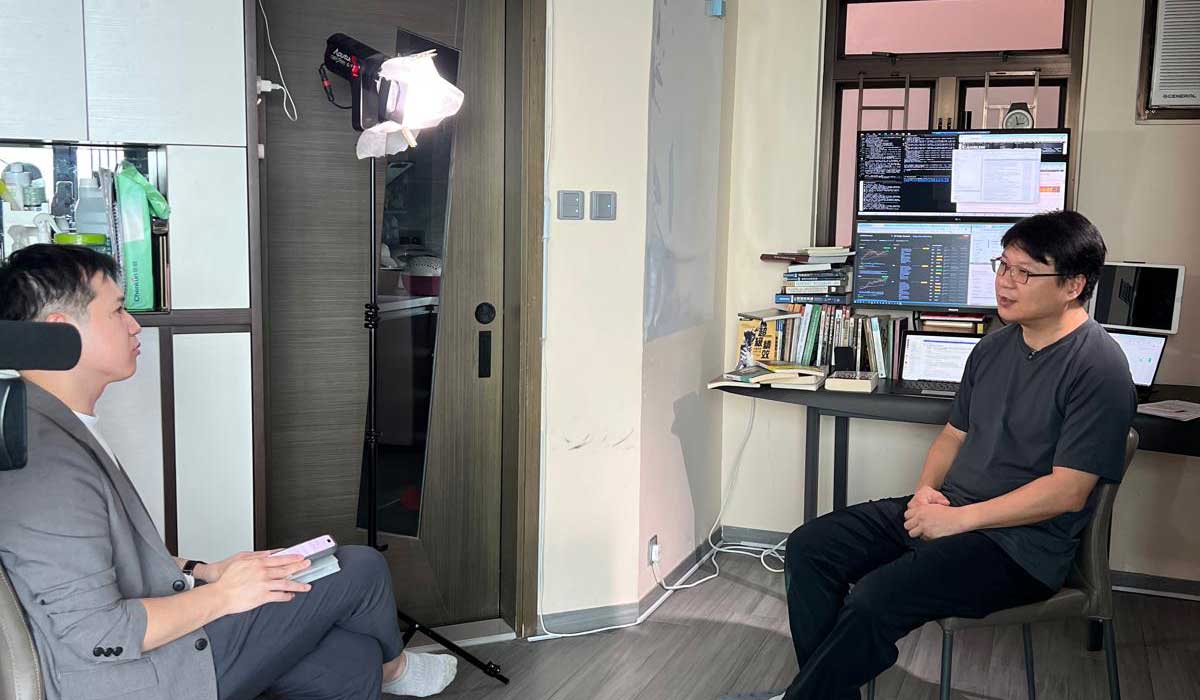
Yesterday, the TVB camera crew set up in my home for an interview. While the official broadcast hasn’t aired yet, I want to give the CANSLIM Research community an exclusive first look at what we discussed.
Because my interview is just one segment of a broader story they are producing, I don’t know the exact angle the final episode will take. However, I want to share the core of our conversation with you firsthand. We dove deep into the engine powering our AI investment research platform, the stark realities of navigating the stock market with artificial intelligence, and how we manage to do the work of a massive analyst team for practically pennies.
From Tech Giant to AI Developer
During the interview, TVB asked me to share the origin story behind our platform. Many of you know me simply as a hobbyist in stock trading, but I detailed my unique journey for the cameras—starting with a BSc (Hons) in Science from HKUST, moving into tech and finance journalism, and eventually spending over 11 years—the longest stint of my career—managing international media and KOL relations at the headquarters of China’s top 5G, cloud computing, and AI chip development giant.
I explained to the TVB audience that my deep dive into AI actually began in 2018, long before the ChatGPT craze. While traveling across Europe, Africa, and Asia for my former company, I witnessed early AI applications in healthcare, public security, and smart grids. When general AI finally went mainstream in 2022, I realized I could automate the tedious process of analyzing thousands of stock charts every week—a personal project that ultimately evolved into the fully automated CANSLIM Research platform we use today.
The Danger of “General AI” in the Stock Market
A major talking point in our conversation was a warning to retail investors. I pointed out a dangerous trend: brokers encouraging everyday investors to use general AI chatbots for stock tips.
“General AI models do not have professional trading logic,” I explained. “If a 7-year-old and a professional analyst ask it the same question, they might get completely different answers. That is very dangerous.”
For our blog members, this is familiar territory. I highlighted how our platform is distinctly different. Instead of relying on open-ended chat models, we programmed our system using the strict, time-tested rules of legendary traders like Jesse Livermore, William O’Neil, Mark Minervini, and others. By turning their strategies into strict algorithms, the AI gains a massive advantage: absolute discipline. It operates without human greed or fear, perfectly executing risk management strategies that human traders often abandon out of emotion.
A 24/7 Analyst: Inside the Platform’s Performance
As part of the segment, the TVB production team captured footage of our AI Traders in action—rapidly processing stocks, running mock trades, and automatically scraping global financial news to generate our “Retail Investor Daily Report.”
I shared our platform’s recent performance metrics with the network. Since mid-August, the AI has autonomously published over 1,300 in-depth articles. More importantly, we discussed the AI’s risk control during the severe tech stock crash this past August. While many retail portfolios suffered heavy losses, our AI model’s portfolio only dropped slightly, outperforming the wider market.
However, I made sure to emphasize a core philosophy of our community on national television: this platform is an experiment in AI logic, not a signal service for blind trading. “I built this to study how AI thinks and to test if master trading strategies still work today,” I noted, explaining how I constantly backtest and rewrite code when the AI misinterprets complex chart patterns.
The $5 Secret: Demystifying AI Costs
Perhaps the most surprising moment of the interview for the TVB crew was our discussion on operating costs. They asked about the financial reality of running a 24/7 AI platform that analyzes massive amounts of data. I revealed that—excluding the development costs of using high-reasoning models—powering our fully automated AI Traders and publishing over 1,300 articles in a single month cost us less than $40 HKD (about $5 USD) in total AI tokens.
I broke down the concepts of “compute power” and “tokens” for the general audience, explaining that the true cost of AI depends entirely on how efficiently a developer processes data. Instead of feeding massive, expensive documents directly to premium AI models, our system uses “local pre-processing.” We use lightweight local algorithms to strip away junk text, apply highly optimized, refined prompts, and format the data before it ever touches the paid AI.
“The real difference in cost comes down to whether you actually know how to use it,” I told them. I also noted that the most expensive aspect of running canslim.blog isn’t the artificial intelligence at all—it’s the premium, real-time financial data feeds we purchase to keep the models accurate.
The Future of the AI Bubble
To wrap up the conversation, I offered a forecast on the broader tech industry. I predicted that the currently high costs of corporate AI—driven by a global shortage of memory—will eventually drop as “Agentic PCs” with built-in AI chips shift basic processing power from the cloud directly to user devices.
However, I noted that this dip will likely be temporary. As we look at the rapid evolution of advanced models like OpenAI Astra, the demand for high-level computing will inevitably surge again. As we edge closer to Artificial General Intelligence (AGI), AI won’t just answer questions; it will autonomously execute highly complex human workflows. For instance, imagine commanding an AI to mock up a newspaper from scratch based on raw text and images. It would need the reasoning to autonomously open layout software like PageMaker or InDesign, convert the photos to CMYK, and output a print-ready PDF. Executing that level of deep, multi-step reasoning requires astronomical compute power—something that will always remain far beyond the capabilities of a local Agentic PC.
I left the TVB audience with a critical metric to watch: the true test of the current AI boom is whether these massive technological investments actually translate into visible cost savings. For any business today, the question isn’t simply whether you are using AI, but whether you have the architectural know-how to achieve a $100 result for just $1.
I am incredibly proud to see our platform’s underlying philosophy featured on such a major stage. I will share the official broadcast link with the community as soon as the segment airs!
Discover more from CANSLIM Research
Subscribe to get the latest posts sent to your email.

