 Andrew@CANSLIM RESEARCH
Red Sea Strikes Reopen a Dangerous New Risk Channel
Deadly attacks on shipping in the Red Sea have returned. The reported six deaths in the Bab el-Mandeb attack are the first fatalities in over a year. This shows the conflict is intensifying again. A U.S. strike on a container ship tied to Iran-related sanctions enforcement signals the situation is spilling beyond the Houthi theater. For growth investors, this is a direct threat to the inflation narrative. Higher geopolitical risk usually supports oil. That keeps inflation concerns alive right before key U.S. data. The market backdrop was already cautious ahead of the CPI report. Fresh Middle East stress adds to the case for volatility. Oil prices jumped approximately 5% on Monday. Brent settled at $87.72. This is not a drill. It is a new variable in an already uncertain equation.
The Volume Tells a Different Story for AI Infrastructure
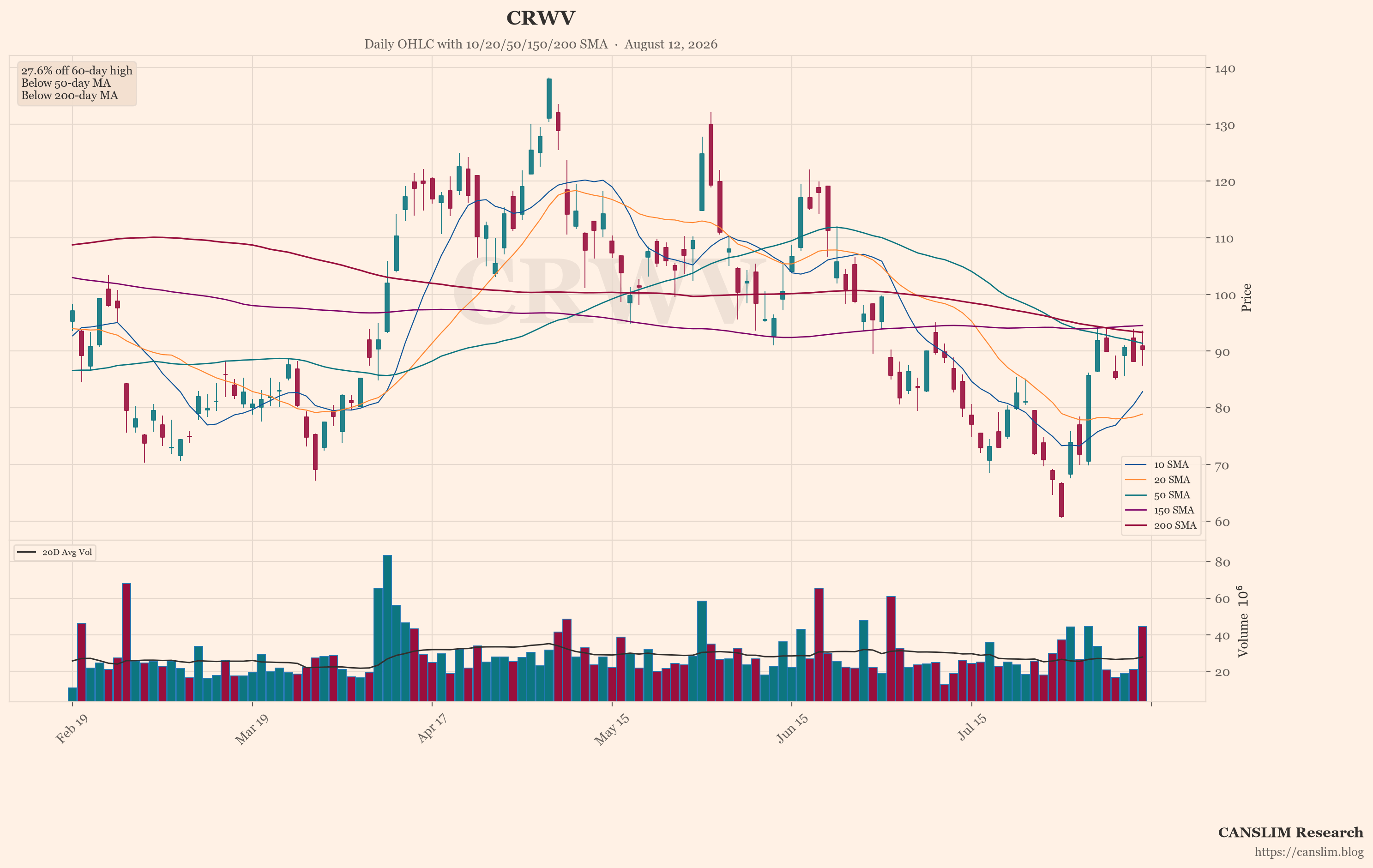
While the macro news was bearish, the after-hours session told a different story. CRWV earnings became the market’s main catalyst. The company reported a Q2 adjusted loss per share of $1.03. That was better than the expected loss of $1.20. Revenue reached $2.58 billion, up 112% year over year. The real headline was the backlog. It surged from $10.42 billion to $12.92 billion in less than six weeks. That is an increase of approximately $2.5 billion in contracted demand. Shares rose as much as 14% after hours. They traded at $103.28 overnight, up 17.70%. The entire AI compute infrastructure chain underwent a collective rerating. NBIS was lifted to 206.09, up 11.48%. IREN rose 6.49%. The online crowd is focused on one thing: the backlog growth proves AI demand is real.
A Management Shell or a Growth Story? The Bear Case Sharpens
The bulls’ central argument is not EPS. It is the $2.5 billion increase in backlog. “AI is real” has become the slogan-like conclusion. However, the bear case has not been disproven. It has become more specific. Some users pointed out that CRWV’s listed entity is essentially a management shell. Its data-center assets have already been pledged to floating-rate creditors NVDA and SoftBank. Annualized interest-related cash outflows are approximately $240 million. The roughly $500 million of cash remaining on the balance sheet is fully earmarked for construction. If the Federal Reserve raises rates, creditors could potentially take control within six months. This is a high-risk, high-reward setup. The featured chart for CRWV shows the weakest technical pattern. That is a warning sign for momentum traders.
Software Drags Nasdaq While Asset Managers Jump
The broader market was frozen ahead of the CPI data. SPY traded at 770.51, down 0.32%. QQQ slipped 0.30% to 719.44. DIA fell 0.15%. Only IWM edged up 0.24%. This marked the fourth consecutive day of narrow sideways trading. Software stocks dragged the Nasdaq lower. Meanwhile, asset managers jumped. The market is waiting for one thing: the July CPI report. It will be released at 8:30 ET on August 12. The previous reading for June was -0.4% month over month and +3.5% year over year. Core CPI was at +2.6% year over year. The online crowd is cynical. They joke about how the data will be “cooked.” The consensus is that cold CPI means stocks fall, hot CPI means stocks fall. This is a complete loss of directional judgment regarding macro data.
The Online Crowd Sees a Policy Shift and a Power Play
Two other stories are moving the sentiment. First, Trump is considering a capital gains tax cut. This is a midterm-election pitch. Republicans remain sharply divided over the deficit. The CBO estimates the fiscal deficit reached $1.8 trillion in the first ten months of 2026. This triggered the community’s most heated policy debate of the after-hours session. Second, Midwestern storms left more than 880,000 customers without power. The community immediately connected this to the utilities and data-center power supply narratives. This is a tailwind for power infrastructure names. Meanwhile, GOOGL declined for a sixth consecutive session. The stock traded at 344.95, down 3.37%. The catalysts were higher capital expenditure guidance and a $4 billion ATM offering program. This is a clear sign of weakness in a former leader.
Defense and Cybersecurity Get a Fresh Bid
The shipping shock is not all bad news. Defense spending may see another bid if regional tensions keep escalating. Cybersecurity remains in focus. Companies and governments face a wider threat environment, including AI-enabled attacks. The online crowd is paying attention to these sectors. They are looking for safe havens within a growth portfolio. The key question is whether this becomes a sustained shipping shock or stays an isolated flare-up. If attacks continue, the implications are straightforward: higher crude, tougher inflation optics, and renewed support for defense and cybersecurity names. If diplomacy works, some of the recent oil bid could fade. For now, the tone is clearly more defensive.
Patience Is a Position in a Two-Front War
This market is fighting a two-front war. On one side, you have geopolitical risk pushing oil higher. On the other, you have a potential cooling in inflation. The CRWV earnings show that AI infrastructure demand is real. But the technical pattern is weak. The online crowd is split between bullish backlog and bearish balance sheet concerns. The smart play is patience. Do not chase the after-hours spike. Wait for the CPI print. Wait for the volume confirmation. The market is frozen for a reason. A single data point will break this logjam. Your job is to be ready for the move, not to predict it. The leaders will emerge after the dust settles. Until then, cash is a position.
Sources: market news brief & global social sentiment data. Updated 2026-08-12 14:53 HKT. For educational purposes only — not investment advice.
Discover more from CANSLIM Research
Subscribe to get the latest posts sent to your email.
