 Andrew@CANSLIM RESEARCH
Jobs Report Ignites Rate Hike Fears, Pressuring Broad Market
The stock market ended lower on Friday after a surprisingly strong jobs report. Employers added 162,000 jobs in August, far exceeding the expected 55,000. This good news for the economy was bad news for stocks. It makes the Federal Reserve more likely to raise interest rates again. The Dow fell 0.5%, the S&P 500 lost 0.38%, and the Nasdaq declined 0.3%. Treasury yields jumped as the odds of a September rate hike climbed to roughly 58%. The market is now repricing risk. Growth stocks, which are sensitive to higher rates, are feeling the most pressure.
The Online Crowd Turns Numb as Political Pressure Mounts
The political pressure on the Fed is rising, but the market seems desensitized. The president publicly demanded lower rates, threatening trade embargoes. He stated, "we should have a 0.5% interest rate." However, the broader market barely reacted to the political noise. The online crowd was more focused on the absurdity of the situation. They noted that while oil, yields, and rate-hike odds are all up, the S&P 500 only fell 0.4%. This shows a market that is resilient but also tightly pinned. The real battle is happening in specific sectors, not the broad indexes.
Memory Chip Mania Drives a Powerful Sector Breakout
While the broader market struggled, memory stocks exploded higher. This was the only major trade making money. MU closed at 1015.00, up 5.91%, breaking above the key 1000 level for the first time. SNDK surged 11.81% to close at its intraday high. AMD gained 4.65%, and MRVL added 6.96%. The catalyst was a forecast for contract prices to rise over 50% for DRAM and 60% for NAND this quarter. The narrative has shifted from an "AI cycle" story to a pure technical breakout. The sector broke out of a two-month consolidation pattern, and the online crowd believes shorting memory now is a terrible idea. The next targets are 1100–1250 for MU, anchored by its earnings report on September 30.
Consumer Giants Absorb the Blow from Rising Yields
The jump in Treasury yields crushed consumer and long-duration assets. LULU was the biggest loser, plummeting 17.39% to close at 100.61. TSLA fell 5.97%, NFLX dropped 5.36%, and AAPL declined 2.52%. MSFT also lost 2.08%. These companies have high valuations that are sensitive to future cash flow discount rates. As yields rise, their present value decreases. This side of the market is absorbing the full impact of the rate hike expectations. The pain is concentrated here, while the money rotates into the hot memory trade.
The Featured Chart Signals a Critical Divergence in Leadership
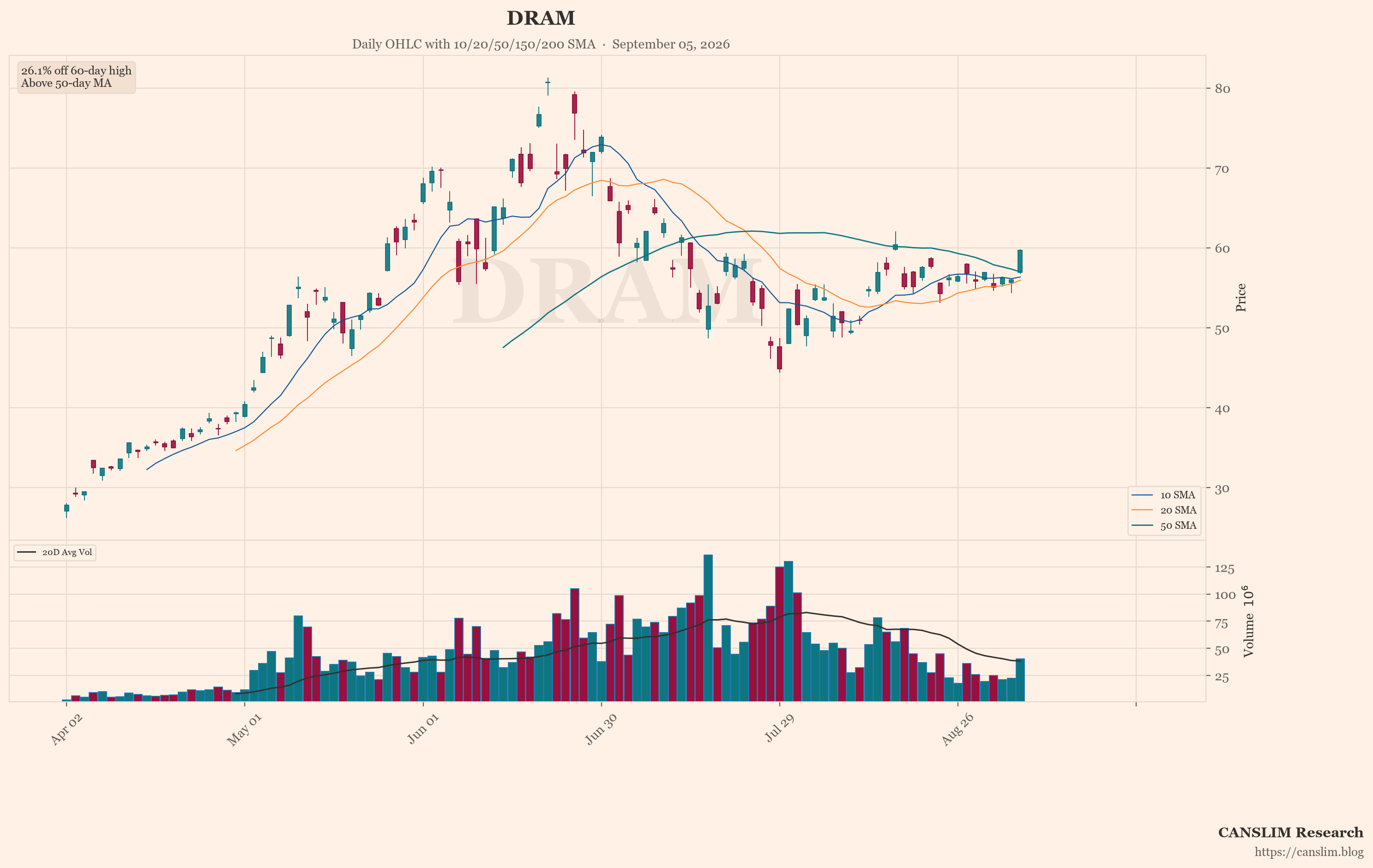
The featured chart for this analysis is DRAM, which currently shows the weakest technical pattern. This is a critical divergence. While the memory sector is surging on price hike news, the broader DRAM ETF is lagging. This suggests the strength is narrow and concentrated in specific large-cap names like MU and SNDK. It does not reflect a broad-based rally in all memory-related assets. For a growth investor, this is a warning sign. It means you must be highly selective. The leaders are leading, but the laggards are not following. This type of narrow leadership can be fragile.
Inflation Data Looms as the Next Major Test for Bulls
The market now faces a major test next week with the CPI report. Headline inflation is expected to rise to about 3.6%, partly due to higher energy prices. Oil is near $93 a barrel, and diesel prices are at a record high. Persistent wage and services inflation could force the Fed to keep tightening. A hot CPI reading could make a September rate hike look certain. This would put more pressure on the rate-sensitive consumer and tech stocks. The market is betting on both extremes. Some traders are buying calls for a big rally, while others are hedging for a crash. Nobody is hedging the middle.
The Divergent Path of Momentum and Value
The current market is a tale of two tapes. One side is defined by momentum and euphoria in memory chips. The other is defined by fear and selling in consumer and tech giants. The online crowd is "greedy" but highly divided. They call MU "free money" while watching LULU get crushed. This divergence is the key to navigating the market. The strongest stocks are breaking out on volume, while the weakest are breaking down. As a growth investor, your focus should be on the strongest names. However, the weak technical pattern in DRAM is a caution flag. It suggests that the current rally may not have the broad support needed for a sustained advance. The market is waiting for the CPI report to decide the next direction.
Sources: market news brief & global social sentiment data. Updated 2026-09-05 06:00 HKT. For educational purposes only — not investment advice.
Discover more from CANSLIM Research
Subscribe to get the latest posts sent to your email.