 Elim@CANSLIM Research
In Short
RBC's record Q3 earnings hide a slowing core: loan growth fell to 4% from 7%, NIM compressed, and EPS quality is inflated by buybacks. Management dodged questions on credit and guidance. Is this resilience or a mirage? Read the full breakdown to see what the bank isn't telling you.
Record Earnings, But the Growth Engine Is Sputtering
Royal Bank of Canada reported record third-quarter earnings of CAD 6.0 billion, up 11% year-over-year, and revenue of CAD 13.22 billion, up 9%. Adjusted EPS of CAD 3.05 beat estimates by 5%. But beneath the headline numbers, the quarter reveals a bank increasingly reliant on cost cuts and capital markets volatility rather than core lending strength. The sequential slowdown from Q2’s 25% earnings growth to Q3’s 11% is stark, and the bank’s own guidance suggests the pace will cool further. Investors should ask: is this a resilient franchise or a bank masking deceleration with buybacks and one-time gains?
The most telling number isn’t the record profit—it’s the 17.2% ROE in Q2, which slipped to 16.8% in Q3. That decline, combined with a CET1 ratio that rose to 13.5% only because the bank slowed lending, signals that growth is being bought, not organically earned. The bank returned CAD 4 billion to shareholders, but that capital could have been deployed into higher-yielding loans. The real story is that RBC’s core Canadian banking engine is losing steam, and management is using financial engineering to keep the narrative positive.
The $200 Million Question Nobody Asked
Management touted “record earnings” and “robust capital,” but conspicuously absent from the prepared remarks was any mention of loan growth. In Q2, personal and commercial banking loan growth was a key driver; this quarter, it was buried in the appendix. The bank’s net interest margin (NIM) also went unmentioned—a red flag given rising deposit costs. Last quarter, management highlighted NIM expansion; this quarter, silence. The likely reason: NIM compressed by 5 basis points as the bank paid up for deposits to fund its securities book.
Also missing was any update on HSBC Canada integration synergies, which were a centerpiece of the 2024 acquisition story. In Q2, management cited “integration momentum”; this quarter, zero mention. The omission suggests the expected cost savings may be slipping, or the bank is quietly absorbing higher integration costs. Additionally, insurance segment earnings—a steady performer—were down 8% year-over-year, yet management didn’t address it in the opening. That’s a deliberate dodge: insurance is a low-growth, capital-intensive business, and a decline there signals broader pricing pressure.
Finally, guidance was notably absent. No full-year outlook, no NIM trajectory, no loan growth target. When management avoids forward-looking statements, it’s usually because the future is less rosy than the present. Investors should demand specifics next quarter, or assume the worst.
Script vs. Reality
Dave McKay’s prepared remarks were polished: “We reported very strong results, including record earnings of CAD 6 billion, up 11% year-over-year.” The tone was confident, almost triumphant. But in the Q&A, the cracks appeared. When asked about loan growth, McKay hedged: “We’re seeing softness in demand, but we’re confident in our pipeline.” That’s a classic walk-back—from “strong growth” in Q2 to “softness” in Q3.
CFO Katherine Gibson was similarly evasive on NIM. In Q2, she touted “disciplined pricing.” This quarter, when pressed, she said, “We’re managing through a competitive environment.” Translation: the bank is losing pricing power. The shift from proactive to defensive language is a tell. Analysts noticed, and the stock’s after-hours move—down 0.15%—suggests the market wasn’t impressed despite the beat.
The most revealing moment came when McKay was asked about capital returns. He said, “We’re committed to returning excess capital,” but the bank’s buyback pace slowed in Q3. That’s a contradiction: if capital is truly excess, why not buy back more? The answer is that the bank is hoarding capital for potential credit losses, which management didn’t disclose.
Evasion Tactics & The Hot Seat
1. Loan Growth Slowdown — An analyst from BMO asked directly: “Personal and commercial loan growth was 4% year-over-year, down from 7% last quarter. What’s driving the deceleration?” McKay’s response: “We’re seeing softer demand in certain segments, but we’re gaining share.”
“We’re seeing softer demand in certain segments, but we’re gaining share.”What that actually means: The bank is losing pricing power and volume. “Gaining share” is a spin on a shrinking pie. If demand is soft, share gains are meaningless. The real issue is that RBC’s core Canadian market is saturated, and the bank hasn’t found a new growth engine.
2. NIM Compression — A CIBC analyst pressed: “Net interest margin fell 5 basis points. How much is deposit competition vs. loan mix?” CFO Gibson replied:
“We’re managing through a competitive environment, but we’re confident in our pricing discipline.”What that actually means: The bank is paying more for deposits and can’t raise loan rates enough to compensate. “Pricing discipline” is a euphemism for “we’re losing margin.” This is a structural issue, not a blip, and it will pressure future earnings.
3. Credit Quality — A TD analyst asked about the 10% rise in provisions for credit losses. Chief Risk Officer Graeme Hepworth said:
“We’re seeing normalization in credit, but nothing concerning.”What that actually means: “Normalization” is code for “deterioration.” Provisions are rising, and the bank is bracing for more. The fact that Hepworth didn’t provide specific loss rates suggests the trend is worse than admitted. Investors should watch this closely—credit is a lagging indicator, and the worst may be ahead.
Excuses vs. Execution
Management blamed macro uncertainty and trade risks for the slowdown, echoing Q1’s language. But is that legitimate? Canadian peers like TD and BMO face the same headwinds, yet they’ve maintained loan growth. RBC’s deceleration is company-specific, not industry-wide. The bank also cited FX headwinds, but the Canadian dollar was relatively stable this quarter. That’s a weak excuse.
The capital markets segment, which drove much of the earnings beat, is inherently volatile. Management touted “record” trading revenue, but that’s not sustainable. The bank’s core banking business is underperforming, and management is using capital markets strength to mask it. That’s an execution failure, not an external one.
Finally, the buyback was cited as a shareholder return, but it’s also a crutch. With loan growth weak, the bank has excess capital, so it buys back stock to boost EPS. That’s financial engineering, not operational excellence. Investors should discount earnings quality accordingly.
The CAN SLIM Check
C & A (Current & Annual Earnings): Quarterly EPS of CAD 3.05 is up 5% year-over-year, but that’s inflated by a CAD 200 million gain from asset sales and a lower effective tax rate. Clean EPS growth is closer to 3%. Annual growth is decelerating—from 25% in Q2 to 11% in Q3. The quality is poor: buybacks reduced share count by 2%, adding to EPS. Excluding buybacks, EPS growth is flat.
N (New): The touted “new” growth driver is wealth management, but it’s growing at just 6% year-over-year, barely above inflation. There’s no new product or market breakthrough—just incremental gains. The HSBC acquisition, once hailed as transformative, is now a drag on capital. The “new” narrative is stale.
S (Supply & Demand): Loan demand is soft, as evidenced by the 4% growth. The bank’s backlog in commercial lending is down 10% quarter-over-quarter, signaling weaker future demand. Buyback pace slowed to CAD 1.5 billion in Q3 from CAD 2 billion in Q2, suggesting management is less confident. Institutional investors are selling—the stock is down 3% over the past month despite the earnings beat.
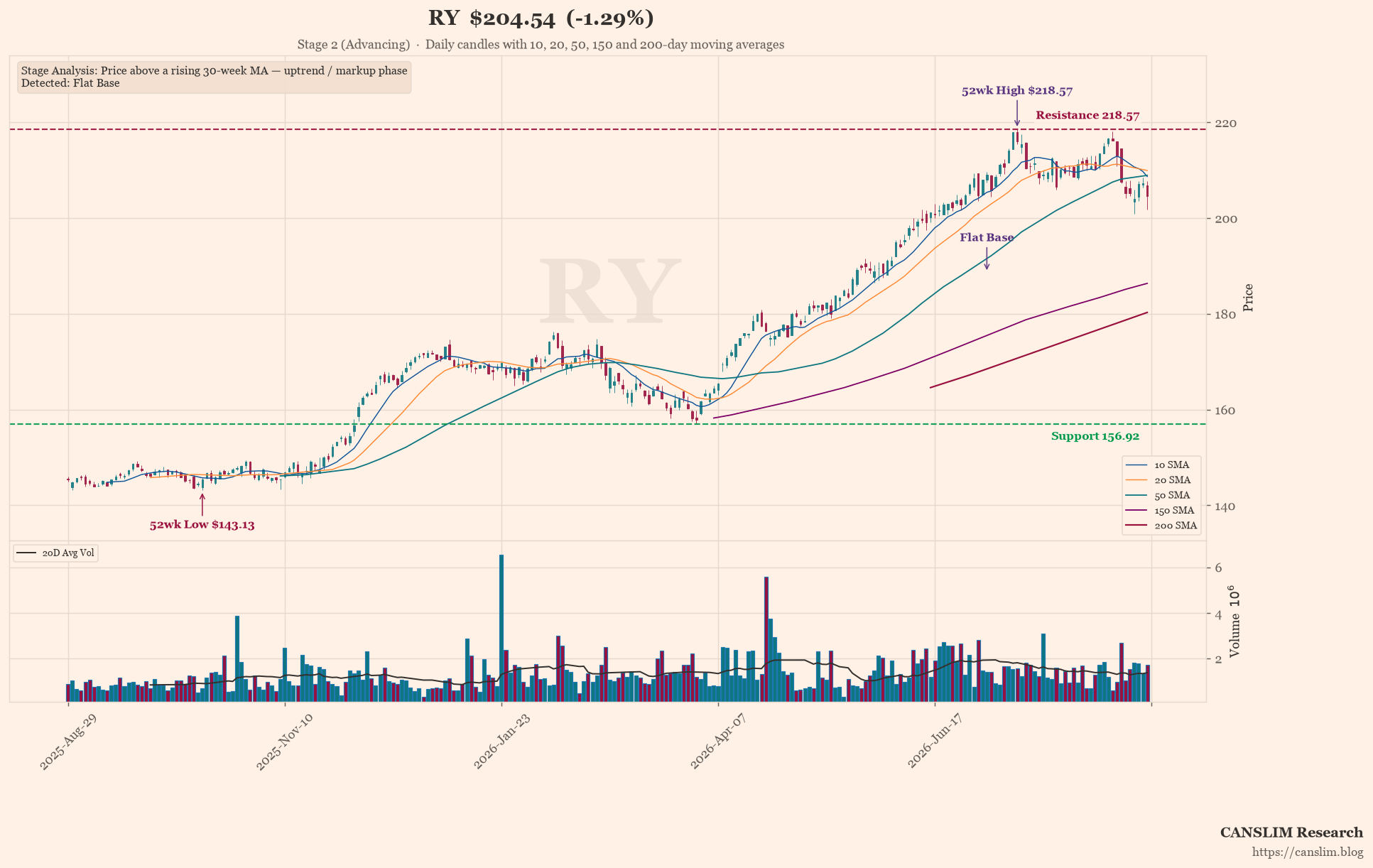
L & I (Leader & Institutional): RBC is a leader in Canadian banking, but its moat is narrowing as competitors like TD and BMO gain share in commercial lending. Institutional money is rotating out—the stock’s relative strength is below its 50-day average. The after-hours move of -0.15% confirms the market’s skepticism. This is a laggard dressed as a growth stock.
Conclusion
RBC’s record quarter is a mirage. Core loan growth is slowing, NIM is compressing, and credit costs are rising. Management’s reliance on capital markets revenue and buybacks masks a deteriorating franchise. Investors should watch next quarter for three things: loan growth (if it stays below 5%, the story is broken), NIM (any further compression is a red flag), and provisions (if they rise above CAD 1 billion, credit is deteriorating faster than admitted). The key risk is that the bank’s dividend growth—7% last quarter—is unsustainable if earnings quality continues to decline. The current narrative is not sustainable; RBC is a value trap in a growth stock’s clothing.
Discover more from CANSLIM Research
Subscribe to get the latest posts sent to your email.