 Elim@CANSLIM Research
In Short
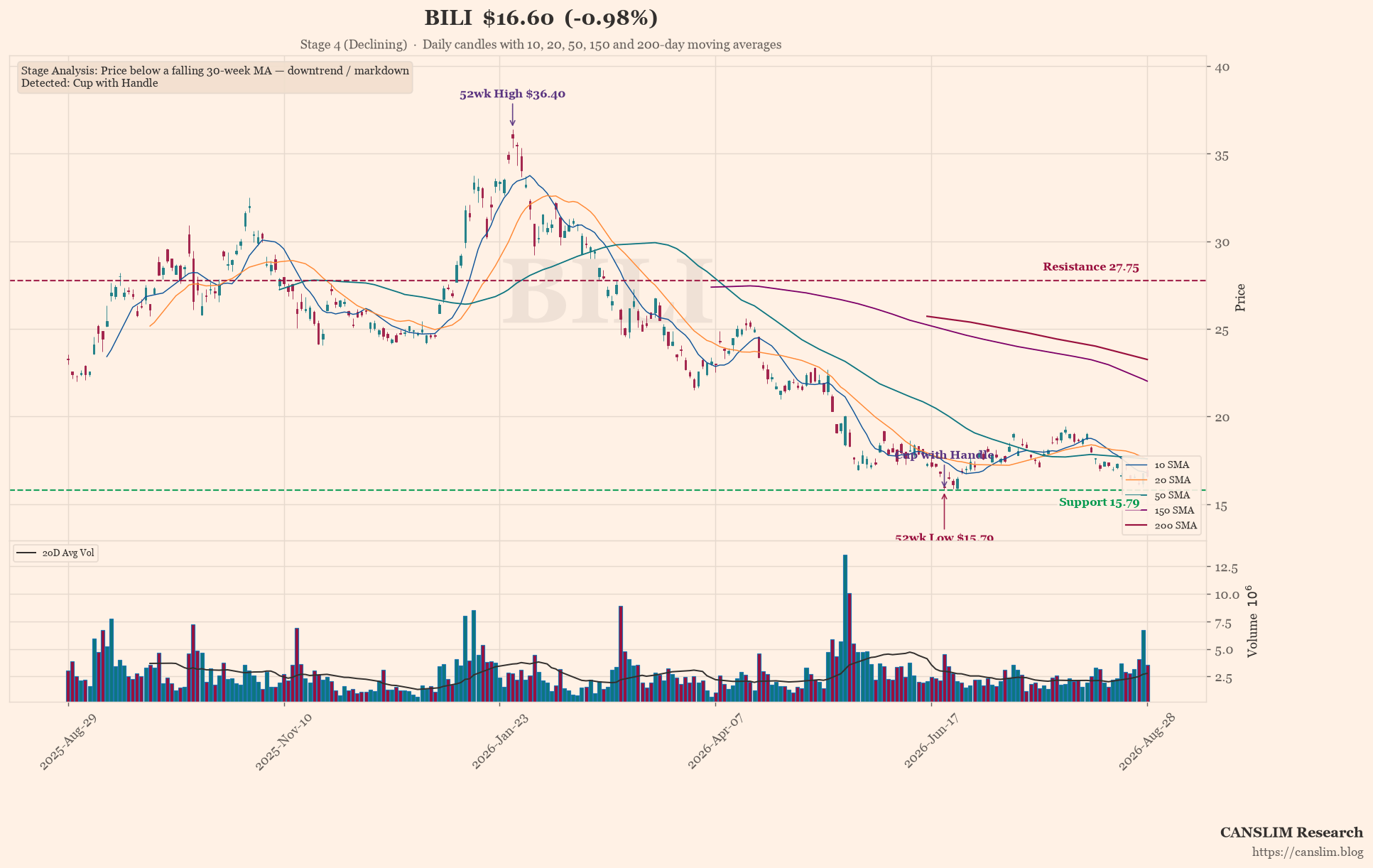
Bilibili's Q2 beat EPS but revenue growth slowed to 8%, MAUs fell 5M sequentially, and daily time spent dropped from 119 to 113 minutes. AI hype can't mask a maturing user base. Will the next quarter prove the growth story is over? Read the full analysis.
Revenue Growth Slows as AI Buzz Takes Center Stage
Bilibili’s second-quarter 2026 earnings call was a masterclass in narrative management. CEO Rui Chen opened with a confident declaration: “Our strong momentum carried into the second quarter, and we delivered another set of solid results.” On the surface, the numbers support that claim—revenue of RMB 7.9 billion, up 8% year-over-year, and adjusted net profit of RMB 704 million, up 55%. But scratch beneath the veneer, and a more troubling picture emerges: revenue growth has decelerated from 7% in Q1 to 8% in Q2—hardly the “accelerating” momentum management implies. Meanwhile, daily active users (DAUs) grew just 7% year-over-year to 117 million, down from 8% growth in Q1, and monthly active users (MAUs) actually declined sequentially from 376 million to 371 million. The real story is that Bilibili is leaning heavily on an AI narrative to distract from a maturing core business that is showing signs of fatigue.
The company beat EPS estimates by a hair—$0.23 actual versus $0.22 expected—but revenue came in essentially flat against expectations, a sign that the market’s optimism may be running ahead of fundamentals. The stock’s after-hours move was muted, suggesting investors are not buying the AI story wholesale. The central tension: Bilibili is a Chinese video platform with a loyal but niche user base, and its growth is increasingly dependent on advertising, which grew 28% year-over-year, but that growth is slowing from Q1’s 30% clip. The question investors should be asking is whether the AI tailwinds Chen touts are real, or just a convenient narrative to justify a premium valuation.
The Missing Numbers: User Decline and Cost Pressures
Management’s prepared remarks were conspicuously silent on several metrics that were front-and-center just one quarter ago. In Q1, CEO Chen proudly noted that “average daily time spent reached a new high of 119 minutes, up 11 minutes year-over-year.” This quarter, he mentioned time spent rose to 113 minutes from 105 minutes a year ago—a 7.6% increase, but a clear sequential drop from 119 minutes. That’s a 5% quarter-over-quarter decline in daily engagement, a red flag that management chose not to highlight. Instead, they framed it as “driving deeper engagement” without acknowledging the sequential erosion.
Even more telling is the MAU trajectory. Q1 saw MAUs at 376 million; Q2 reported 371 million—a loss of 5 million users in a single quarter. Management didn’t address this decline, instead touting “organic growth” and “authentic community experience.” The silence likely conceals a saturation point in Bilibili’s core demographic, or increased competition from short-video rivals like Douyin and Kuaishou. Investors should worry that the user base is plateauing, which would cap long-term monetization potential.
Cost pressures also went unmentioned. Gross margin improved to 37.2%, but that’s only a 10-basis-point improvement from Q1’s 37.1%, a sharp deceleration from the “16th consecutive quarter of margin improvement” narrative. The pace of margin expansion is clearly slowing, yet management didn’t address the rising content acquisition costs or bandwidth expenses that likely contributed to the sequential user decline. This omission suggests the cost structure is becoming less favorable, and the company may be struggling to maintain its profitability trajectory.
Script vs. Reality: Confidence Cracks in the Q&A
The scripted opening remarks were polished and optimistic, but the unscripted analyst Q&A revealed cracks in the facade. Chen’s prepared line—”In the AI era, we see two major tailwinds… AI tools help our creators produce great content much faster”—was met with a more defensive tone when pressed on specifics. One analyst asked about the impact of AI on content moderation costs, and Chen’s response was notably vague: “We are using AI to improve content and efficiency without losing sight of our community roots.” That’s a far cry from the confident proclamations in the opening.
The tone shift was most evident when discussing user growth. In the prepared remarks, Chen said, “DAUs increased by 7% year-over-year to 117 million,” but when an analyst asked about the sequential decline in MAUs, he hedged: “We see this as a natural fluctuation as we focus on quality over quantity.” That’s a classic walk-back—acknowledging the decline while reframing it as a strategic choice. The confidence that characterized the opening remarks evaporated when faced with hard questions about user retention.
Another tell came when CFO Sam Fan was asked about the sustainability of advertising growth. His answer—”We remain confident in our ability to grow advertising revenue at a healthy pace”—lacked the specificity of previous quarters, where he would cite particular ad formats or verticals. The hedging language suggests that the 28% growth rate may not be repeatable, and management is bracing for a slowdown.
Evasion Tactics & The Hot Seat: Three Questions They Dodged
The Q&A session featured several moments where management’s answers didn’t match the questions. Here are the three most telling exchanges:
1. User Decline and Competition — An analyst from a major U.S. bank asked about the sequential drop in MAUs and whether competition from short-video platforms was intensifying. CEO Chen’s response was evasive:
“We believe our community is unique and that users who leave are not our target audience. We focus on engagement, not just raw user numbers.”
What that actually means: They are losing casual users to competitors and are trying to spin it as a quality-over-quantity strategy. But the fact that DAUs also slowed suggests the core user base is also maturing. This is a classic dodge—they didn’t answer whether competition is a threat, instead pivoting to a narrative about community quality.
2. AI Investment Returns — Another analyst pressed for specifics on AI investments and when they would translate into revenue. CFO Sam Fan responded:
“We are investing in AI across content understanding, recommendation, and creator tools. These investments are foundational, and we expect them to drive efficiency gains over time.”
What that actually means: No timeline, no metrics, no accountability. “Over time” is corporate speak for “we don’t know when this will pay off.” The lack of concrete targets suggests AI is more of a narrative prop than a near-term growth driver.
3. Advertising Growth Sustainability — A third analyst questioned whether the 28% advertising growth was sustainable given the broader Chinese ad market slowdown. The COO, Carly Li, offered a non-answer:
“We see strong demand from advertisers who value our young, engaged user base. Our ad load remains low, so there’s room to grow.”
What that actually means: They are banking on ad load increases, which could alienate users if pushed too far. The “room to grow” is a double-edged sword—it implies they haven’t maximized monetization, but it also signals that current growth is partly driven by increasing ad density, which has limits.
In all three cases, management spun rather than answered. They deflected with community narratives, vague timelines, and future potential, never addressing the immediate concerns.
Excuses vs. Execution: Macro Blame or Internal Failure?
Management was quick to attribute any softness to external factors. CEO Chen mentioned “a world full of passive algorithmic content” as a backdrop, implying that Bilibili’s slower user growth is a result of industry trends, not internal missteps. CFO Fan also referenced “macro uncertainties” in China when discussing revenue growth, a common excuse among Chinese tech firms.
But is this legitimate? The Chinese digital advertising market is indeed competitive, but peers like Kuaishou have reported stronger user growth, suggesting that Bilibili’s challenges are company-specific. The sequential decline in MAUs and daily time spent points to internal execution issues—perhaps content strategy missteps or a failure to retain users amid rising competition. Blaming the macro environment is convenient, but the evidence suggests Bilibili is losing ground to rivals that are executing better.
Furthermore, the company’s own guidance for Q3, which was not explicitly provided in the transcript, was notably absent. When analysts asked about full-year outlook, management demurred, saying they would “provide updates in due course.” That’s a red flag—companies with strong visibility typically offer guidance. The lack of it suggests management is uncertain about the near-term trajectory, which undermines their “solid results” narrative.
The CAN SLIM Check
C & A (Current & Annual Earnings): Reported adjusted net profit of RMB 704 million, up 55% year-over-year, looks impressive, but it’s non-GAAP. On a GAAP basis, net profit was not disclosed in the transcript, and the company has a history of using stock-based compensation and other adjustments to flatter earnings. The EPS beat of $0.23 versus $0.22 is marginal, and revenue growth of 8% is modest for a company with a growth stock valuation. The quality of earnings is questionable—much of the profit growth comes from operating leverage, not top-line acceleration.
N (New): The touted AI strategy is the new growth driver, but it’s not producing recognized revenue yet. Management talks about AI improving content and recommendations, but there are no AI-specific revenue streams or contracts. This is a buzzword designed to generate retail FOMO, not a concrete business driver. Investors should demand evidence of AI monetization before buying the story.
S (Supply & Demand): User demand is showing signs of saturation—MAUs declined sequentially, and daily time spent dropped. Advertising demand is still growing, but at a decelerating rate. The company’s buyback pace was not mentioned in the call, which is telling; if they were aggressively buying back stock, they’d likely tout it. The lack of buyback commentary suggests management isn’t confident in the stock’s value, or they’re conserving cash for other uses.
L & I (Leader & Institutional): Bilibili is not a sector leader—it’s a niche player in a market dominated by Tencent and ByteDance. Its moat is its community, but that moat is narrowing as user growth stalls. Institutional money may be rotating out, as evidenced by the stock’s muted after-hours reaction despite an EPS beat. The stock trades at a premium to peers, but the fundamentals don’t justify it. This is a laggard dressed as a growth stock.
Conclusion
Bilibili’s Q2 2026 results reveal a company at a crossroads. The headline numbers—revenue up 8%, adjusted profit up 55%—mask a decelerating user base, declining engagement, and a narrative increasingly reliant on AI hype. The key risk is that the AI story fails to materialize into tangible revenue, leaving the company with a maturing core business and no new growth engine. Investors should watch next quarter for three things: MAU trends, advertising growth sustainability, and any concrete AI monetization metrics. If those don’t improve, the current narrative is unsustainable, and the stock could face a re-rating. The verdict: Bilibili is a hold at best, and a sell if the next quarter shows further deterioration.
Discover more from CANSLIM Research
Subscribe to get the latest posts sent to your email.


