 Andrew@CANSLIM RESEARCH
Markets start the week with a clear theme: policy risk is back. The biggest swing factors are the Fed, oil, and currency intervention. The yen got a modest lift after signs that Japan and the U.S. are ready to act together again. This matters because a weak yen feeds import costs and volatility across Asia. Traders are now cautious about rebuilding yen shorts too quickly.
At the same time, the market waits on heavy U.S. inflation data. That data could decide if the Fed keeps pausing or leans back toward tighter policy. This backdrop collides with renewed oil stress tied to the Strait of Hormuz. The result is a market with support from earnings and AI spending, but forced to price in a more volatile macro setup. Rates, energy, and geopolitics can all move together now.
The Volume Tells a Different Story for Space Leaders
Two space-sector earnings reports landed on the same night, and both stocks were hammered. RKLB reported revenue of $234 million (+62% YoY), beating expectations. Neutron remains on track for its maiden flight in Q4, and the company added a new Iridium contract. However, its net loss reached $49.3 million, and its loss per share of $0.08 was worse than the expected $0.05. The stock closed Monday at 80.04 (-3.37%) and fell further overnight to 74.39, down 12.8% from last Friday.
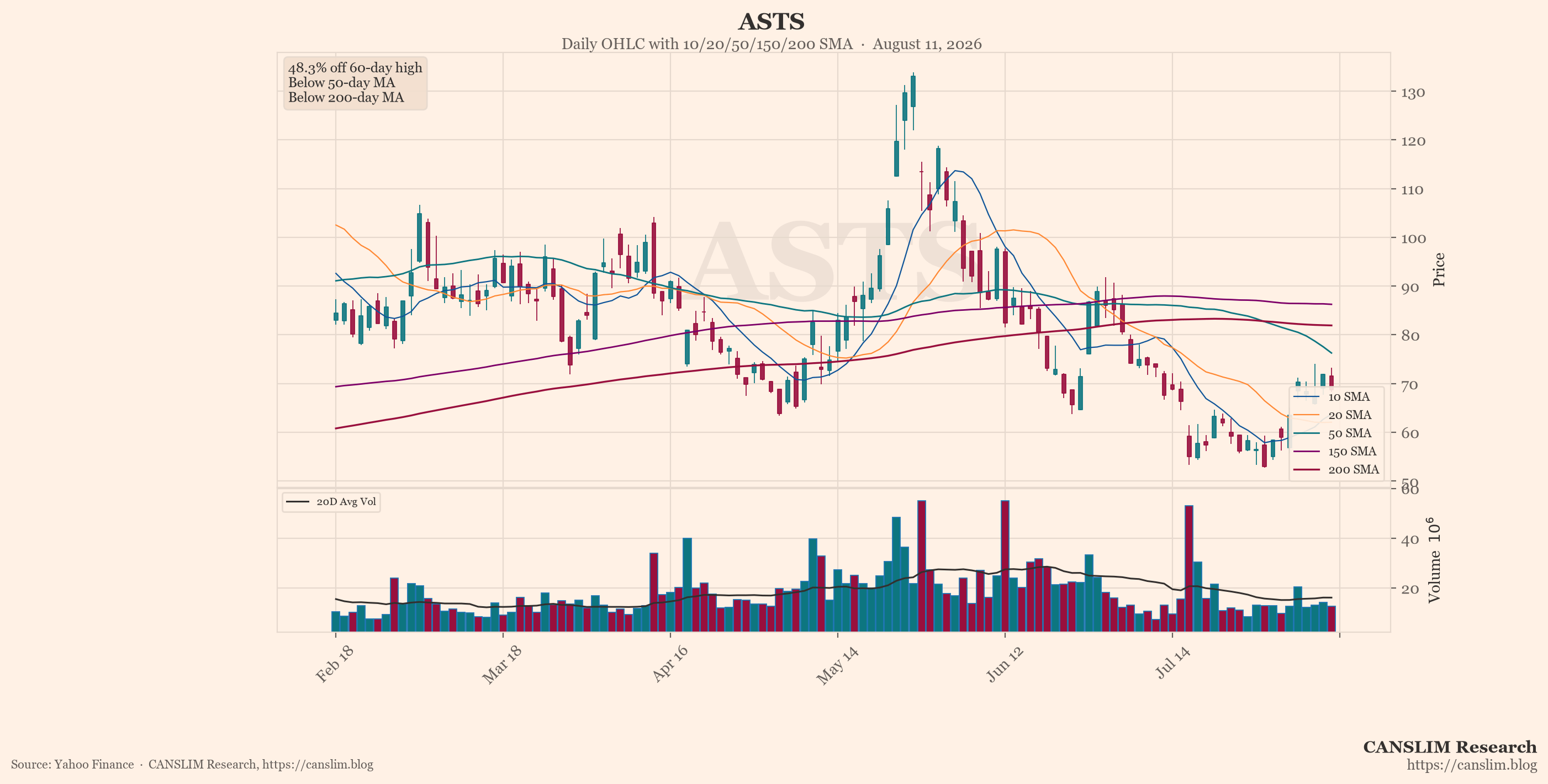
ASTS reported revenue of $31.5 million, below the expected $35.18 million. Its adjusted loss per share of $0.77 was far worse than the expected $0.26. Q2 capex surged to $610 million, but backlog grew to $1.3 billion. Full-year guidance of $150–200 million was reaffirmed. The stock traded at 68.25 overnight, with a notably smaller decline than RKLB. The featured chart for ASTS shows the weakest technical pattern. The online crowd calls this a “localized bloodbath.” The pain is concentrated in single-stock exposure, not the index.
Oil’s New Normal Crushes Risk Appetite
Iran’s hard-line stance weighed on risk appetite and pushed oil higher. Iran’s Foreign Ministry said reopening the Strait of Hormuz would depend on the U.S. lifting its blockade and compensating Iran for war losses. Iran’s foreign minister stated there were “no negotiations with Washington, only messages through intermediaries.” Trump described the situation as “half-negotiations” and demanded compensation from Iran. Brent rose 4.66% to $87.44. WTI gained more than 5%. USO traded overnight at 126.22 (+5.2% from last Friday).
The community’s reaction shifted from anger to entertainment. This usually means the risk has been absorbed into the narrative rather than fully priced into markets. A few sober voices point out the real transmission mechanism: oil prices → CPI → interest rates. They note “the U.S. has shale; Europe and Asia are the ones getting trapped.” Polymarket’s below-50% probability of the strait reopening this year was cited as a warning sign.
Inflation Data Is the Gatekeeper for Fed Policy
Markets moved sideways on the eve of CPI. Consensus estimates for the 8/12 CPI report are +0.2% MoM and 2.5% YoY for core CPI, with headline CPI at 3.4% YoY. Hawkish Fed comments brought the possibility of a September rate hike back into discussion. The 10Y yield reached 4.637%. SPY traded overnight at 773.12 (-0.19%). QQQ at 722.69 (-0.44%). IWM at 299.83 (-0.57%). Indexes remain stuck in a narrow range just a few dollars below all-time highs. GLD continued to strengthen at 404.50 (+1.2%).
Two inflation reports over the next month will shape whether Fed officials push to raise rates in September or extend their pause. Wednesday’s crucial CPI report will show tamer inflation, according to prediction markets. The online crowd is fatigued. The mood is “angry sideways-market fatigue + repeated earnings betrayals.” Fear/Greed is approximately 40/100 (Neutral, leaning toward fear). Gold is repeatedly described as the “last hope.” Users openly flaunt cash positions, a sign of rising defensive sentiment.
Capital Still Flows Into Strategic Growth Themes
Despite the noisy macro tape, capital is still flowing into strategic growth and defense-related themes. JPMorgan will keep its Asia hiring pace after corporate bank growth tops 20%. Morgan Stanley will facilitate a $1.5 trillion infrastructure initiative. Hanwha is making a U.S. shipbuilding bid. Defense, shipbuilding, and strategic industrial themes are gaining attention as governments push supply-chain resilience.
Corporate earnings growth is no longer driven just by tech. This broadening support is a bullish sign. AI capex remains powerful, but the benefits are still concentrated in select names. Intel increased its equity offering from $15 billion to approximately $20 billion, with subscription demand exceeding $100 billion. The deal was priced at approximately $95, a discount of roughly 6.5%. INTC traded overnight at 97.92 (-5.3% from last Friday), making it a drag on semiconductors.
AI Leasing Surges While the Crowd Turns Defensive
AI compute leasing activity continued to surge. RIOT announced a 191MW, 20-year lease worth approximately $9.1 billion for a frontier AI lab at its Rockdale campus. It also reported better-than-expected Q2 results. The stock traded overnight at 24.11 (+16.4%). Fermi America soared after securing a $6.5 billion lease from TensorWave. NVDA’s $500 billion customer-financing platform with six major asset managers remained a major topic, with NVDA trading overnight at 218.72.
The online crowd is torn. There are still numerous calls to “buy more RKLB on the dip” and go “full port RKLB 2028 calls.” This suggests fear has not fully overwhelmed the urge to gamble. But the defining feature is “localized bloodbaths, aggregate numbness.” SPY fell only 0.1%, yet the forum was flooded with bearish posts. The pain comes from concentrated single-stock exposure, not the index.
The Tape Demands Patience, Not Panic
The market is stuck in a narrow range, trapped between strong earnings support and macro headwinds. Oil, rates, and geopolitics can all move together now. The next CPI and PPI prints will be the gatekeepers. Any fresh signaling from Washington and Tokyo on currency action matters. Oil staying elevated could change the Fed narrative. The featured chart for ASTS shows the weakest technical pattern, a warning for speculative longs. The online crowd is agitated but not panicking. Cash positions are rising, and gold is seen as the last hope. For growth investors, this is a time for patience. Let the data speak. Let the volume confirm. The leaders will survive, but the laggards will not.
Sources: market news brief & global social sentiment data. Updated 2026-08-11 09:19 HKT. For educational purposes only — not investment advice.
Discover more from CANSLIM Research
Subscribe to get the latest posts sent to your email.