 Andrew
General educational commentary only, generated automatically with AI. Not investment advice or a recommendation to buy, sell or hold any security. Capital is at risk.
Futures Slip as Chip Export Rules Tighten
US stock futures were down about 0.4% early Tuesday, according to a market brief citing Invezz. The S&P 500 had already logged a third straight decline. The Wall Street Journal reported that US stocks extended their slide on fears tied to Nvidia and China. The Commerce Department moved to further limit chip shipments to China, a step reported by the Wall Street Journal. That adds uncertainty for semiconductor sales and for the wider AI trade.
Fund Managers Cut Technology Exposure Sharply
A Bank of America survey, cited by Reuters, showed fund managers cut technology exposure by the most since 2006. The brief describes this as a sharp shift away from crowded tech positions. One reading is that caution around megacap tech has grown after a long period of heavy reliance on the group. The same survey could also leave room for a rebound if earnings reassure investors, though that is uncertain. The brief presents both sides without a firm conclusion.
Nvidia Results Seen as a Test for AI Demand
Investors are waiting for Nvidia's results and outlook. The brief says these could clarify whether demand still supports the sector's high expectations. Reuters described a shaky semiconductor trade facing a big week, with investors looking for a bottom. The brief treats the earnings event as neutral in direction. It may reset expectations for AI demand and data-center spending, or it may not. The outcome is not known in advance.
Rate Comments and Dividend Forecasts Add Caution
Fed official Alberto Musalem said several rate hikes may be needed by spring, according to Reuters. The brief says this raises the risk that inflation keeps policy restrictive. Bond yields edged lower as investors sought fresh drivers, the Wall Street Journal reported. That offered a modest counterpoint. Separately, a Seeking Alpha article cited in the brief said S&P 500 dividend projections declined for most quarters through the end of 2027. The brief reads this as a sign that expectations have cooled.
Online Sentiment Turns Defensive on Tech Themes
Online sentiment, as reflected in unverified posts by anonymous retail users, has turned more defensive toward technology and semiconductor themes, based on the brief's bearish tone. Such posts may include rumour or speculation and have not been checked. They are not a measure of institutional flow or confirmed positioning. At the theme level, the discussion appears focused on AI leadership, China export policy and data-center spending. This commentary does not repeat specific claims from those posts. One interpretation is that retail tone often follows price action, so the two may be echoing each other rather than leading.
Chart Screen Flags Nasdaq Weakness on Several Measures
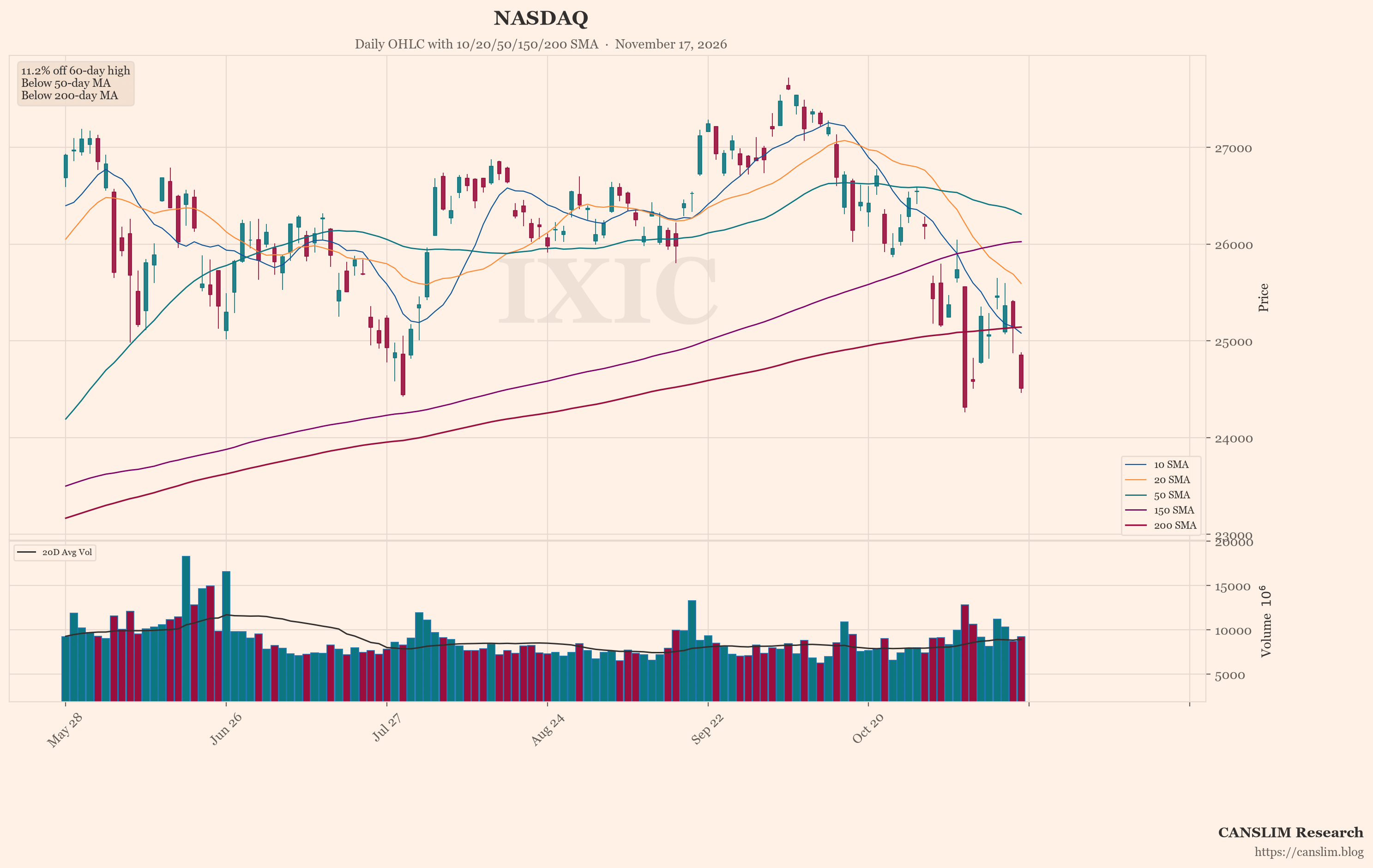
The featured chart shows the Nasdaq Composite (^IXIC). An automated technical screen selected it because, among the indices and stocks it checked, it showed the most weakness on a few measures. These were distance from its recent high, position versus its 50-day and 200-day moving averages, and down days on higher volume. This is one screen and not a full view of the market. Past price patterns do not predict future results. The reading is descriptive, not a signal about what comes next.
Mixed Signals Leave Direction Unclear
Conditions described in the brief point in different directions. Futures were lower, the S&P 500 had fallen three sessions in a row, and tech exposure was cut sharply. New China chip rules and rate-hike comments added pressure. Against that, lower bond yields and the possibility of reassuring earnings kept the picture from being one-sided. Weaker dividend projections suggested cooler expectations. Online sentiment leaned defensive, though such posts are unverified and may be wrong. The main risks are a disappointing Nvidia outlook, further export restrictions and inflation that keeps policy tight. The main uncertainty is whether demand for chips and data centers holds up. The brief does not settle these questions, and the screen's weakness reading is only one input among many.
Sources: a third-party AI-generated market news summary, and an AI summary of unverified posts by anonymous retail users online. This article was written by an AI language model from those summaries and published automatically without human review. Updated 2026-11-17 22:00 HKT.
CANSLIM Research (canslim.blog) is an independent educational publisher. It is not licensed or registered as a broker, investment adviser, research analyst or asset manager in any jurisdiction. This article is general information for education only. It is not investment advice, a research report, an investment recommendation, or an offer or solicitation to buy or sell any security, and it does not consider any reader's objectives, financial situation or needs. No ticker, chart, heading or technical comment is a suggestion to buy, sell, hold or short. Figures come from third-party sources, are not independently verified, and may be incomplete, out of date or wrong. Online sentiment may include rumour, speculation or coordinated posting. Past performance and past price patterns do not predict future results. Investing involves risk, including the loss of capital. This article is not updated after publication. Laws differ by country; seek advice from a licensed professional in your jurisdiction before making any investment decision.