 Andrew@CANSLIM RESEARCH
The Bond Market Seizes Control of the Tape
The stock market has a new boss, and it is the long-term Treasury yield. The 30-year yield pushed above 5.31%, a level not seen in 19 years. The 10-year hovered near 4.7%, its highest since 2007. This is not background noise anymore. This is the main driver of risk sentiment. When the long end of the curve sells off, borrowing costs rise for mortgages, auto loans, and corporate funding. The hit is bigger than a few weak trading sessions. It is a direct threat to the economy and to the valuations of high-growth tech names. The market is now questioning whether the government can finance its debt without forcing rates even higher.
A Brutal Session for Semiconductors and AI Leaders
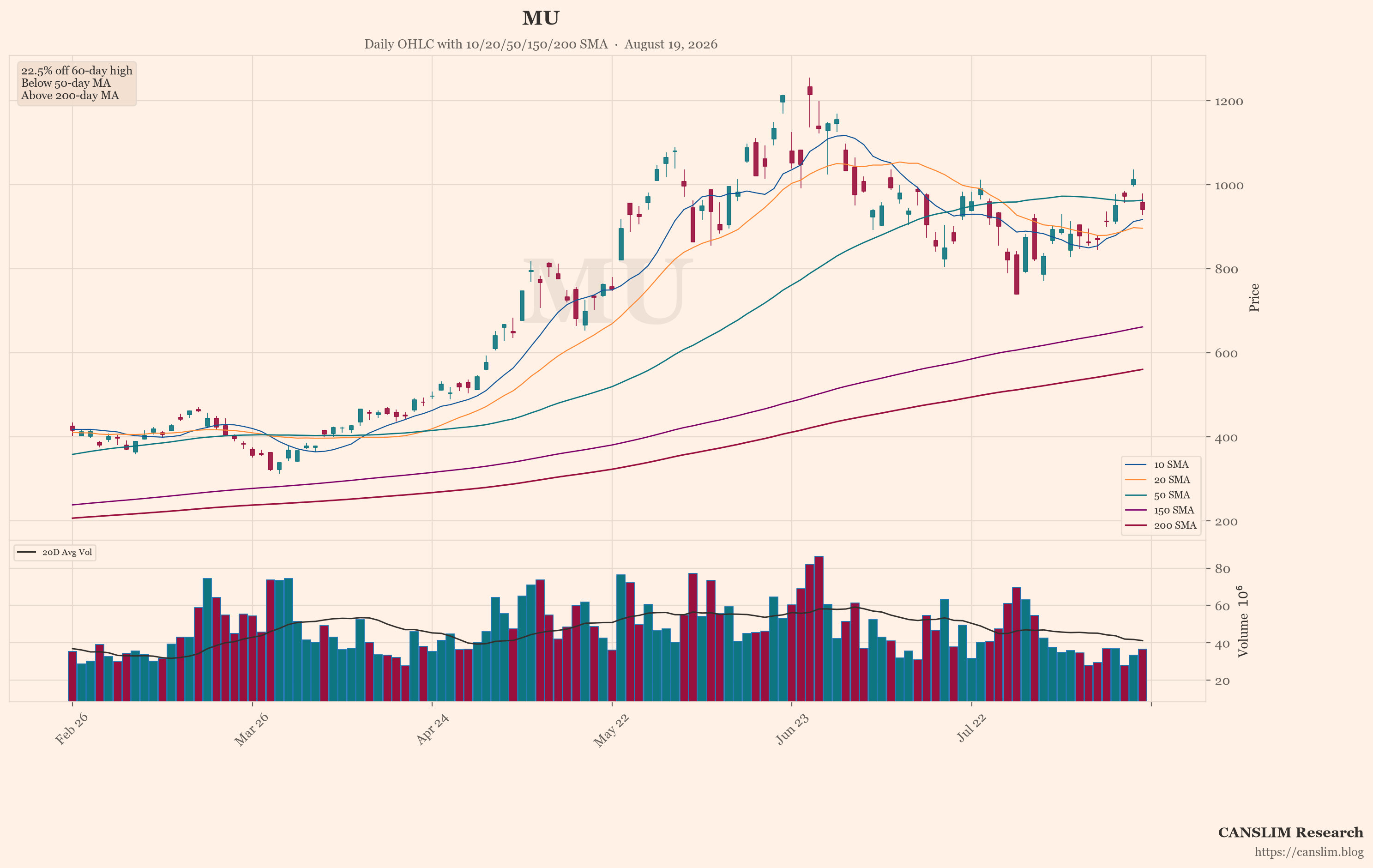
The damage was concentrated in the high-beta tails of the market. The Philadelphia Semiconductor Index fell more than 5%, erasing over $680 billion in market cap. The featured chart, MU, showed the weakest technical pattern, closing down 7.16% at 939.63. It was not alone. SNDK dropped 9.24%, STX fell 8.69%, and INTC lost 7.21%. The memory giants that had just hit record highs gave back all their gains in a single session. The AI narrative was hit from both directions. NVDA fell 2.54% to 219.39, while NBIS dropped 7.71%. This is a clear signal that even the strongest leadership is vulnerable when rates spike.
The Online Crowd Feels Bear Market Pain While Indexes Stay Calm
Global social sentiment is bearish, but it is closer to resentment than panic. The crowd is confused. SPY is only about 1.5% below its all-time high, and DIA is nearly flat. Yet many traders describe losses resembling the middle of a bear market. The central complaint is that the indexes are pinned near 768, while individual stocks fall 5% to 10%. The community repeatedly notes, "SPY is down 0.6%, while my stock is down 10%." The pain is real, but it is isolated to AI, memory, and other high-beta names. The few holding GOOGL, AAPL, MSFT, or NKE were the only ones in the green.
Geopolitics and Tariffs Add Fuel to the Fire
The bond selloff is not happening in a vacuum. Geopolitical tension around Iran is keeping oil elevated, with Brent crude near $91. Iran fired two ballistic missiles toward the UAE, and the Strait of Hormuz has remained largely blocked since late February. This adds another layer of inflation and growth worry. On top of that, a midnight deadline looms for U.S.-Canada negotiations over 50% tariffs on $20 billion worth of goods. These factors reinforce the idea that this is not a one-day rotation. The selloff is spreading globally, lifting yields in Japan, Germany, and France. The market is treating this as a real regime shift.
The Divergence Between Indexes and Individual Stocks Is the Story
The key takeaway is the extreme divergence between the broad market and individual stocks. SPY had an all-day range of just 767.38–769.50. It was a boring, pinned tape. Meanwhile, SOXL crashed 15.87%. The online crowd is furious about market makers and manipulation, but the structural issue is clear: volatility has shifted to after-hours and overnight sessions. Intraday returns are negative over the long term. The lesson being validated this week is that only overnight positions make money. For growth investors, this means the risk is not in the index; it is in the high-beta names that are getting crushed by rising rates.
When Yields Stabilize, Leaders Will Emerge
The near-term watchlist is clear. Will the 30-year yield keep making new highs? Will the bond rout spill further into equities? If yields stay elevated, the market's resilience gets a tougher test. Expensive money is starting to matter again. However, if yields stabilize, some pressure could ease quickly, especially outside the most expensive growth names. The upcoming retail earnings will show whether higher rates are already slowing consumer demand. For now, the market is treating this as a real shift. The featured chart, MU, shows the weakest technical pattern, and it is a warning for all high-beta momentum names. The smart play is to wait for the bond market to find its footing before committing new capital. The leaders that survive this test will be the ones to buy.
Sources: market news brief & global social sentiment data. Updated 2026-08-19 06:00 HKT. For educational purposes only — not investment advice.
Discover more from CANSLIM Research
Subscribe to get the latest posts sent to your email.