 Andrew@CANSLIM RESEARCH
The Market Holds Its Breath as Oil and Inflation Collide
Wall Street opened the week with a cautious tone. Investors weighed a fresh spike in oil prices against unresolved uncertainty around the Strait of Hormuz. Oil rose almost 2% after Iran said reopening the waterway still depends on U.S. concessions. This keeps a key geopolitical risk alive for energy, shipping, and inflation-sensitive assets. At the same time, markets are heading into a heavy week of U.S. inflation data. That data will help shape the Fed outlook. It could either reinforce or undermine the recent equity rally.
The bigger picture shows a market pulled in two directions. On one hand, earnings growth is broadening beyond mega-cap tech names. That is constructive for the rally's durability. On the other hand, AI spending still looks like a margin tailwind for the biggest platform companies, not the rest of corporate America. Higher oil prices add another layer of pressure to inflation and rate expectations. The near-term watch list is simple: CPI, PPI, retail sales, and any new headlines on Hormuz. Those will tell investors whether this is a healthy pause or the start of a tougher tape.
The Online Crowd Sees Chaos While Indices Sit Frozen
Global social sentiment shows extreme irritation but not panic. Both bulls and bears got hurt. The universal consensus was that there was "no direction at all." Indices hugged the flatline for a fifth straight day. The only real volatility came in the final five minutes of trading. Implied volatility in space-sector earnings trades was completely crushed. The online crowd interpreted this as collusion between algorithms and market makers, not a natural market condition.
The fear and greed level sits near 40 out of 100. That is anxious but lacks directional panic. The real pain is concentrated among holders of high-beta individual stocks—space, memory, and semiconductors. Notably, almost no one discussed cash allocations or systematic hedging. There were only scattered mentions of VIX calls, and those were treated as jokes. The market's lack of direction is frustrating traders more than any single headline.
Space Earnings Deliver a Double Blow to High-Beta Hopes
Two space-sector earnings reports landed on the same night. RKLB reported Q2 revenue of $234.1 million, about 1% above expectations. EPS was in line, and the backlog hit $2.36 billion. Yet the stock closed down 3.2% at 80.19. The community directed its firepower at the Neutron timeline. Accusations like "Peter Beck is lying" and "RKLB is a $15 stock" appeared frequently.
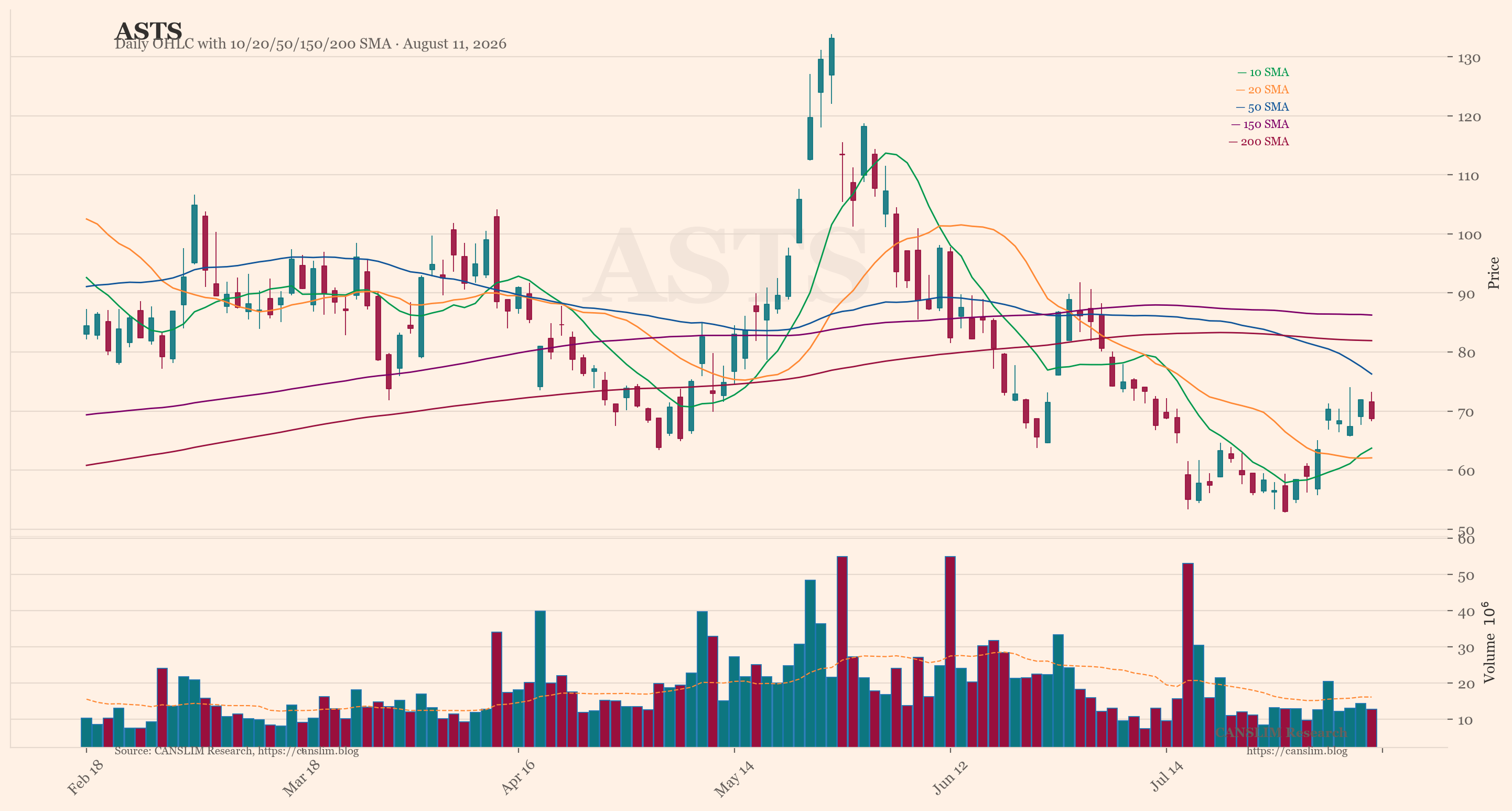
ASTS missed expectations for the Nth consecutive quarter. Revenue came in at $31.5 million, below the $34.5 million estimate. Backlog increased to $1.3 billion, and full-year guidance was maintained. After hours, it traded at 71.52, virtually unchanged. This wiped out directional options traders on both sides. The prevailing conclusion was that the earnings reports no longer mattered. What mattered was the IV crush and the algorithmic selloff scheduled for exactly 5:00.
A small number of rational voices pointed out that both companies have market capitalizations in the tens of billions but only $200–300 million in revenue. Their valuations were never tied to quarterly figures in the first place. As one trader put it, "Whether they fall depends only on whether the story has been updated." Some began accumulating shares during the decline with a 2030 horizon. The featured chart for ASTS shows the weakest technical pattern, confirming that the story has not been updated for the better.
Semiconductors Collapse While One Memory Name Bucks the Trend
Semiconductors collectively collapsed into the close. SOXL closed at 131.38, down 6.28%. AMD fell to 469.71, a 2.81% drop. MU plunged vertically in the final minutes to 866.90, down 1.31% including after-hours trades. SNDK bucked the trend and closed at 1238.23, up 2.10%, but retreated from an intraday high of 1278. The divergence shows that even within a beaten-down sector, selective strength exists.
At the index level, SPY finished at 772.82, down 0.04%. QQQ closed at 721.07, down 0.25%. DIA slipped to 539.11, and IWM fell to 299.85. The S&P 500 closed at 7753.11, virtually unchanged. The lack of movement at the index level masks the pain underneath. High-beta names are getting hit hard while the broad market sits flat. This is a classic sign of distribution beneath the surface.
Oil's Surge and Rates Create a Sticky Inflation Cocktail
The Strait of Hormuz standoff escalated, sending oil prices soaring. Iran demanded that the U.S. end military threats, lift sanctions, and provide compensation before reopening the strait. A transit agreement with Oman has yet to materialize. Brent crude rose more than 3% intraday to above $84. USO closed at 125.95, up 6.72%. It was one of the strongest assets of the day, sharply contrasting with flat equity indices.
Rates and fiscal concerns once again became headwinds. The 10-year yield rose more than 4 basis points to approximately 4.70%. TLT closed at 82.10, down 0.77%. CBO data showed the deficit for the first ten months of FY2026 reached $1.8 trillion. July alone saw $431 billion borrowed. July CPI is scheduled for release on Wednesday, August 12. Higher oil prices could become a problem for inflation just as investors hoped for more room for the Fed to ease.
NVIDIA's Big Announcement Fails to Lift the AI Trade
NVIDIA joined forces with six major asset managers to establish an AI compute financing platform. The company signed a memorandum with Apollo, BlackRock, Blackstone, Brookfield, Goldman Sachs, and KKR. The goal is to mobilize more than $500 billion in third-party capital and turn compute capacity into a "collateralizable asset class." The announcement coincided with a CNBC roundtable featuring Jensen Huang, Larry Fink, and David Solomon.
Despite the news, NVDA closed at 219.16, down 2.13%. It was one of the biggest drags among large-cap stocks that day. The market's reaction shows that even massive capital commitments are not enough to push the AI trade higher right now. The benefits of AI capex remain concentrated in a handful of mega-cap names. This does not boost margins across the broader market, which is a key concern for the rally's sustainability.
The Data Week Ahead Will Decide the Market's Next Move
Wednesday's crucial CPI report will show tamer inflation, according to prediction markets. If inflation data stays tame, the recent equity rally can keep running. If not, rate-cut bets may get pushed out. The Dow's slight decline and cautious tone suggest traders are not ready to chase stocks ahead of the data. The market is at a crossroads, and the next two days will likely set the tone for the rest of August.
A Market Frozen by Conflicting Forces
This market is stuck between bullish breadth and bearish oil. Earnings growth is broadening beyond tech, which is good. But higher oil prices and rising rates threaten to undo that progress. The online crowd is frustrated by the lack of direction, and high-beta names are getting crushed. The featured chart for ASTS shows the weakest technical pattern, a warning for speculative positions. The path forward depends on Wednesday's CPI report and any new Hormuz headlines. Until then, expect more of the same: flat indices, violent individual moves, and a market waiting for a catalyst.
Sources: market news brief & global social sentiment data. Updated 2026-08-11 06:00 HKT. For educational purposes only — not investment advice.
Discover more from CANSLIM Research
Subscribe to get the latest posts sent to your email.

