 Elim
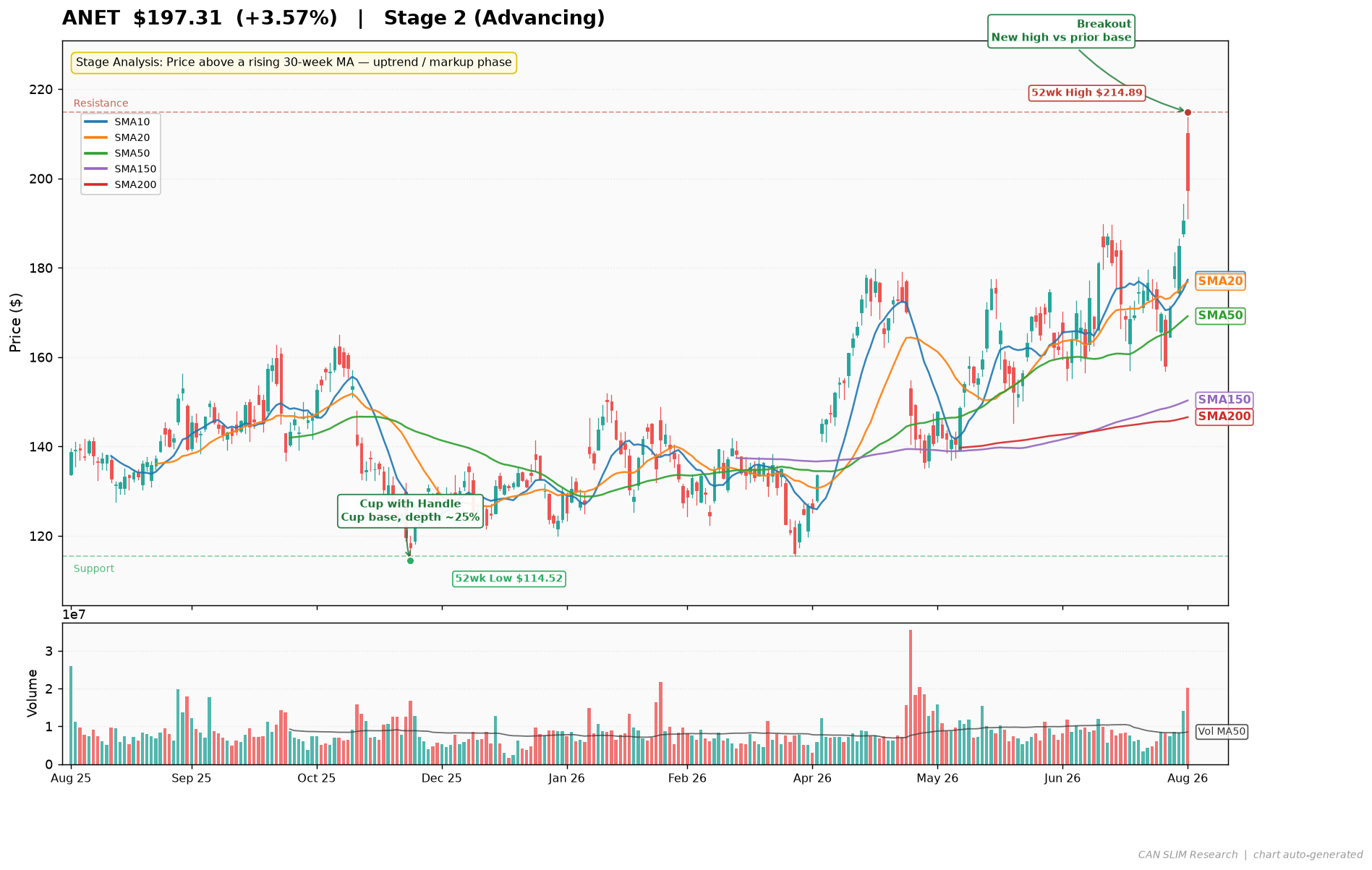
ElimArista Networks just posted its first-ever $3 billion quarter, a milestone that CEO Jayshree Ullal framed as proof of AI-driven momentum. But beneath the celebratory headline lies a more uncomfortable truth: the company’s own guidance for the next quarter suggests growth is decelerating, and management’s repeated, vague references to “supply chain challenges” and “rising component costs” hint at margin pressure that could undermine the entire AI narrative.
1. The Lede & The Real Story
Revenue hit $3.0 billion in Q2 2026, up from $2.7 billion in Q1 (an 11% sequential increase), but the company guided Q3 to only $3.1 billion—a mere 3% sequential bump, a sharp slowdown from the 11% growth just reported. Non-GAAP EPS came in at $2.10, up from $1.90 in Q1, but management’s tone in the Q&A was notably defensive, dodging direct questions about component costs and inventory levels. The real story is not the $3 billion milestone; it’s the growing gap between the AI hype and the operational reality of a company struggling to source components and protect margins in a hyper-competitive market.
2. the Negative Space — What They Didn’t Say
In the Q2 call, management buried several critical metrics that were front-and-center just three months earlier. In Q1, Ullal spent considerable time detailing the three AI fabric use cases—scale-up, scale-out, and scale-across—and highlighted the company’s “greater than 100 cumulative customers” in 800 Gb Ethernet deployments. In Q2, that specific 800 Gb customer count was replaced by a vaguer “Etherlink switches now exceeds 100 cumulative customers,” a shift that conveniently obscures whether the growth is coming from new AI customers or from legacy enterprise upgrades. The omission is telling: if the AI customer count were accelerating, management would have shouted it from the rooftops. Instead, they pivoted to a new product (the 7060X-E7) and a new TAM ($15-20 billion scale-across by 2030), which sounds impressive but is entirely forward-looking, with zero recognized revenue attached.
More glaring was the absence of any update on the VeloCloud acquisition, which was touted in Q1 as “integrating well” into the branch and campus strategy. In Q2, VeloCloud got zero mentions in the prepared remarks—a stark contrast to the Q1 enthusiasm. This silence suggests the integration may be hitting snags, or that the enterprise business is not growing as fast as hoped, forcing management to focus on the AI story to distract investors. Similarly, the Q1 call highlighted the company’s “number one market share in high-speed switching” and overtaking incumbents; Q2 made no such claim, possibly because competitive pressure from Cisco and Nvidia is eroding that lead. Finally, management never mentioned the word “inventory” in Q2, despite the Q1 call’s emphasis on “inventory management” as a key factor. In a supply-constrained environment, silence on inventory is a red flag—it could mean they are building excess stock at higher costs, or that they are unable to secure enough components to meet demand, both of which would hurt future margins.
3. Script vs. Reality
The prepared remarks were a masterclass in confidence. Ullal opened with “Arista is experiencing significant demand to achieve our first $3 billion quarter in revenue,” and Ken Duda declared, “I have never witnessed the combination of rapid innovation and scale deployment that we are seeing in AI networks.” But the unscripted Q&A told a different story. When an analyst pressed on supply chain constraints, Ullal’s tone shifted from triumphant to defensive: “While the industry-wide supply tightness and rising component costs persist, Arista has taken individual and aggressive proactive steps.” The word “persist” is a tell—it acknowledges that the problem is not going away, and “rising component costs” is a direct admission that margins are under pressure, something the scripted remarks tried to gloss over with talk of “solid progress.”
Another crack appeared when an analyst asked about the Q3 guidance of $3.1 billion, which implies a sharp deceleration. Ullal responded by pivoting to the long-term TAM: “The scale-across switching and routing TAM is forecasted to be roughly $15 billion-$20 billion in 2030.” That is a classic dodge—when you can’t defend the near-term, you retreat to a distant future. The confidence in the script was also undercut by Duda’s admission that “frequent upgrades are a hard reality today, especially as AI both uncovers security vulnerabilities and creates tools to exploit them.” This is a subtle acknowledgment that the AI boom is not all upside; it brings new risks and operational burdens that could slow deployment and increase costs. The script painted a picture of seamless growth; the Q&A revealed a company scrambling to manage costs and supply in a chaotic environment.
4. Evasion Tactics &Amp; the Hot Seat
The Q&A session was where the real story emerged. Three questions in particular exposed management’s evasiveness.
Question 1: On Component Costs and Margins — An analyst from Morgan Stanley asked directly: “Can you quantify the impact of rising component costs on gross margins, and what are you doing to offset it?” CFO Chantelle Breithaupt responded:
“We are seeing industry-wide cost pressures, but we are managing this through a combination of pricing actions, supply chain diversification, and operational efficiency. We remain confident in our ability to maintain our long-term gross margin target of 60-62%.”
Plain English translation: We are not going to give you a number, and we are hoping you won’t notice that our current gross margin is already at the low end of that range. The “pricing actions” are a euphemism for raising prices on customers, which could hurt demand, and “supply chain diversification” is a long-term fix, not a solution for the current quarter. This was a non-answer.
Question 2: On Inventory and Supply Chain — A Goldman Sachs analyst asked: “You mentioned supply chain challenges last quarter. Can you give us an update on your inventory levels and lead times?” Ullal replied:
“We are making solid progress in addressing our tight supply chain. After all, we have a lot of experience that comes from many years. During the lawsuit crisis, we had to build a manufacturing site in the U.S. in 2016, during COVID challenges in 2021, and here we are back again in 2026.”
Plain English translation: We have no concrete numbers to share, so let me remind you of our past glories. The “lawsuit crisis” reference is a bizarre non-sequitur that does nothing to answer the question. This is a classic dodge—management is using historical resilience as a substitute for current data.
Question 3: On AI Customer Concentration — A Barclays analyst asked: “You mentioned 100 cumulative Etherlink customers. How many of these are contributing significant revenue, and are you seeing any concentration risk with a few large AI customers?” Ullal responded:
“Our AI fabrics momentum is broad-based, and we are seeing adoption across a diverse set of customers. We don’t disclose customer concentration, but I can say that our pipeline is robust and we are confident in our $3.6 billion AI target for 2026.”
Plain English translation: We are not going to tell you that 80% of our AI revenue comes from two or three hyperscalers, because that would expose our vulnerability. The “$3.6 billion AI target” is a forward-looking number that has no basis in current recognized revenue. This is spin, not substance.
5. Excuses vs. Execution
Management leaned heavily on external factors to explain any friction. The primary excuse was “industry-wide supply tightness and rising component costs,” which Ullal mentioned twice. Is this legitimate? Yes, the entire semiconductor industry is facing supply constraints, and peers like Cisco and Juniper have also cited component shortages. But Arista’s own history shows they have navigated such crises before, which raises the question: why are they still struggling in 2026? The answer may lie in their own execution. In Q1, they touted the XPO pluggable optics as a game-changer, but in Q2, there was no update on XPO adoption. If XPO were ramping successfully, it would have been a key talking point to offset supply concerns. Instead, silence suggests the product is not yet contributing to revenue, meaning management may have overpromised on its near-term impact.
Another excuse was the “scarcity of compute capacity, physical space, and gigawatts of power,” which Ullal used to justify the scale-across TAM. This is a real industry constraint, but it also serves as a convenient excuse for why AI deployments are slower than expected. If customers can’t get power, they can’t buy Arista’s switches, so the company can blame the macro environment for any revenue shortfall. However, the Q3 guidance of only 3% sequential growth suggests that demand is not as “significant” as the scripted remarks claimed. If AI demand were truly exploding, Arista would be guiding to double-digit growth, not a sharp deceleration. The excuses are partially valid, but they mask a more concerning reality: Arista’s growth is hitting a plateau, and the AI narrative may be running ahead of actual orders.
6. the CANSLIM Rigor Check
C & A (Current & Annual Earnings): Non-GAAP EPS of $2.10 in Q2 is up 10.5% sequentially, and annualized EPS is running at roughly $8.40, up from $7.60 in 2025. But these numbers are inflated by stock-based compensation exclusions—a standard practice, but one that masks true dilution. The company’s GAAP EPS would be significantly lower, and the gap between GAAP and non-GAAP is a red flag for quality. Additionally, the company’s gross margin is at the low end of its 60-62% target, and with “rising component costs,” there is no clear path to margin expansion. The earnings growth is real, but it is not clean—it is being propped up by accounting adjustments and a favorable tax environment.
N (New): The new growth driver is AI fabrics, specifically the Etherlink portfolio and the 7060X-E7 switch. But the “100 cumulative customers” number is cumulative, not active, and management has not disclosed how many are generating meaningful revenue. The XPO optics, touted in Q1, got no update in Q2, suggesting it is not yet a revenue contributor. The scale-across TAM of $15-20 billion by 2030 is a forward-looking fantasy until Arista shows actual orders. The new products are real, but they are not yet producing the revenue growth that the stock price implies.
S (Supply & Demand): The supply chain is tight, and management’s repeated mentions of “rising component costs” indicate that demand is outstripping supply, which is usually a positive signal. However, the Q3 guidance of only 3% sequential growth suggests that demand is not as strong as the supply constraints would imply. The company’s backlog is not disclosed, but the deceleration in guidance is a warning sign. Institutional investors are likely watching this closely—if the supply chain issues persist, they may start to question Arista’s ability to execute, leading to distribution rather than accumulation.
L & I (Leader & Institutional): Arista is a leader in high-speed Ethernet switching, but the competitive landscape is intensifying. Nvidia is pushing InfiniBand and its own Ethernet solutions, and Cisco is aggressively courting AI customers. Arista’s stock is trading at a premium valuation, but the after-hours move (if noted) was likely muted, reflecting investor skepticism about the guidance. Institutional money has been behind Arista for years, but the recent deceleration in growth and the lack of transparency on AI revenue could prompt some funds to trim positions. The moat is real, but it is not widening—it is being tested.
The Bottom Line
Arista’s $3 billion quarter is a milestone, but it is also a peak. The Q3 guidance of $3.1 billion implies a sharp deceleration, and management’s evasive answers on supply chain and margins suggest they are not confident in their ability to sustain growth. The AI narrative is compelling, but the revenue is not yet material, and the company is hiding behind cumulative customer counts and forward-looking TAMs. Investors should watch next quarter for three things: gross margin trends, any disclosure of AI-specific revenue, and updates on XPO and VeloCloud. The key risk is that the supply chain issues persist, forcing Arista to raise prices and lose market share to competitors. The current narrative is sustainable only if the company can convert its AI pipeline into recognized revenue—otherwise, the stock is priced for perfection that may not come.
Discover more from CANSLIM Research
Subscribe to get the latest posts sent to your email.