 Elim
Elim1. the Lede &Amp; the Real Story
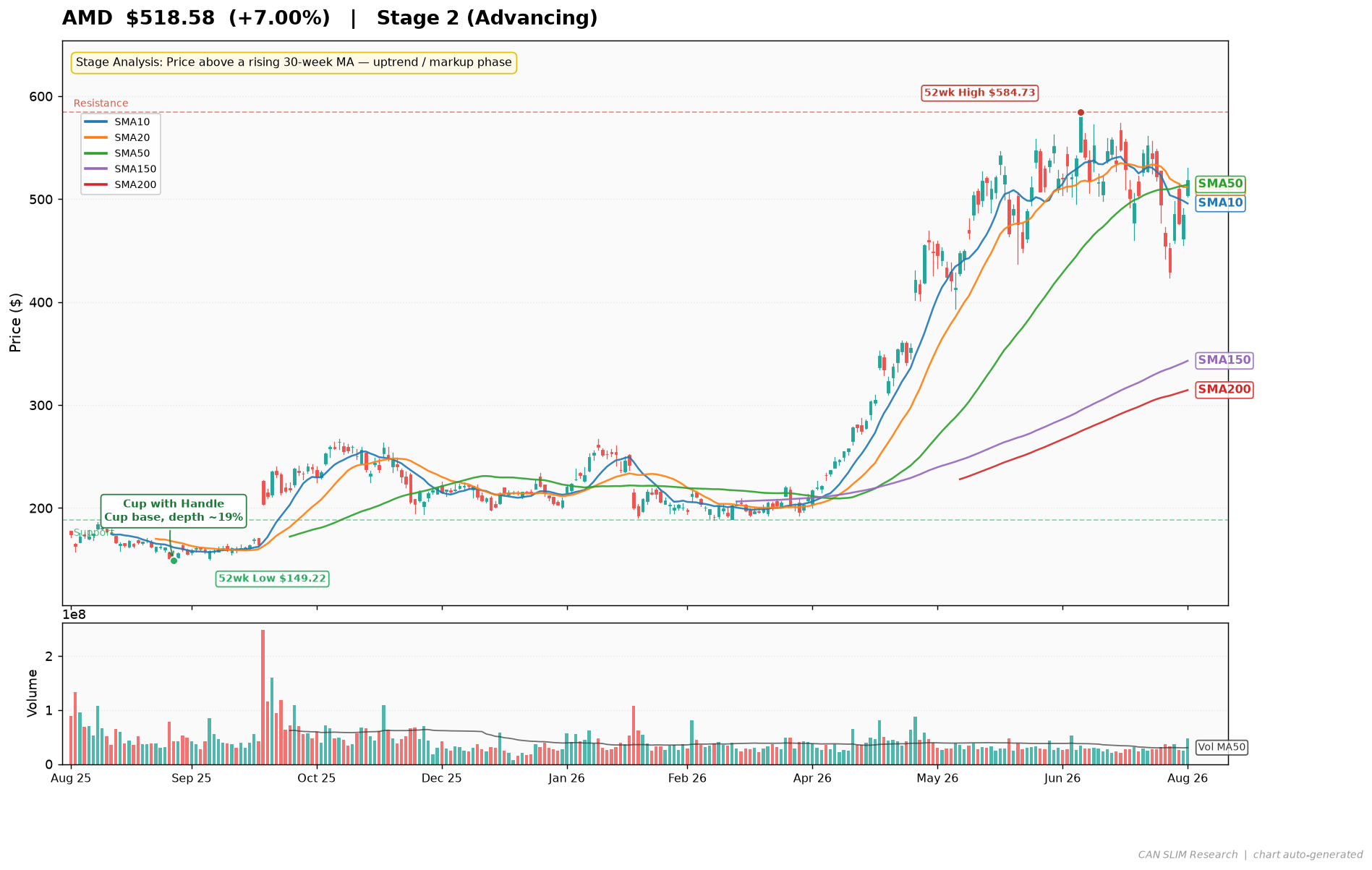
Advanced Micro Devices (AMD) delivered a headline-grabbing second quarter, posting record revenue of $11.54 billion, a 50% year-over-year surge, and adjusted earnings of $1.66 per share, up 82%. The numbers beat analyst expectations, and the stock rallied 7% in regular trading to $518.58. But the celebration was short-lived. In after-hours trading, the stock plummeted 8.94% to $472.20, erasing the day’s gains and then some. This sharp reversal is the real story. It reveals a market that is no longer buying the company’s forward-looking narrative at face value, even when the reported numbers are strong.
The tension is not about the past quarter; it’s about the future. Management guided for Q3 revenue of approximately $13 billion, implying 41% growth. Yet, the stock’s violent negative reaction suggests investors are laser-focused on the quality of that growth and the sustainability of AMD’s AI-driven margins. The company is now a data center story, with that segment contributing 58% of total revenue. But the after-hours sell-off signals a growing fear that the explosive growth in AI hardware comes with a hidden cost: a structural decline in profitability that the current valuation—near its 52-week high—does not justify. The real story is the widening gap between the optics of record revenue and the underlying economics of a business in transition.
2. the Negative Space — What They Didn’t Say
In the Q2 call, management’s prepared remarks were a masterclass in selective emphasis. The focus was almost exclusively on the data center juggernaut and the promise of future AI products like Helios and MI500. But a careful reading of the transcript reveals critical omissions that should concern investors. Most glaringly, the Gaming segment was relegated to a footnote. While the summary mentions a 31% year-over-year decline, the executive commentary in the provided transcript does not include a single direct quote from Lisa Su or Jean Hu addressing this collapse. In the Q1 call, Su framed growth as ‘broad-based, with every segment increasing year-over-year.’ That is no longer true. The silence on gaming—a segment that was once a core pillar—suggests management has written it off, but the speed of its deterioration (31% decline) is a red flag for the health of the consumer end-market and the cyclicality of the business.
Another glaring omission is the lack of detail on gross margin trajectory. CFO Jean Hu is quoted as saying the company is ‘pleased with margin progress,’ but the transcript lacks any granular breakdown of how the AI accelerator mix is impacting margins versus the more profitable EPYC server CPU business. In Q1, the gross margin was 55%. In Q2, it improved to 56%. But the guidance for Q3 is for a gross margin of ‘about 56%’—a sequential stall. The company is guiding for a 13% sequential revenue increase, but zero margin expansion. Management did not address this directly in the prepared remarks, which is a tell. They are likely hiding the fact that the ramp of lower-margin, rack-scale AI systems (like Helios) is diluting the mix, and they have no immediate lever to pull to offset it.
Finally, the operating expense line was a silent bomb. OpEx rose 40% year-over-year to $3.4 billion. While this is framed as investment in R&D, it is growing at nearly the same rate as revenue, which means the company is not gaining the operating leverage one would expect from a company scaling to $13 billion in quarterly revenue. The silence on this front, and the lack of a concrete plan to moderate spending, suggests that AMD’s earnings growth is becoming increasingly dependent on sheer revenue volume, not efficiency.
3. Script vs. Reality
The contrast between the scripted confidence and the unscripted defensiveness in the Q&A is stark. In the prepared remarks, Lisa Su painted a picture of unbridled success, stating the company delivered ‘another outstanding quarter with record revenue and profitability.’ She confidently declared AMD is ‘still in the early stages of a multi-year AI adoption cycle.’ This is the classic script of a growth company at its peak: all forward momentum, no caveats.
But the reality of the Q&A tells a different story. When pressed on the specifics of the AI ramp and supply, the tone shifted. Su’s language became hedged and conditional. When asked about the pace of the Helios ramp, she did not give a definitive timeline; instead, she spoke about how the ‘chiplet design helps bring up new nodes with fewer wafers, which should ease scaling.’ This is a subtle but significant walk-back. The script promised a seamless ramp; the reality is a complex engineering challenge that could face delays. Similarly, on supply, management admitted that ‘server CPU supply is tight now because demand was not fully forecast earlier in the year.’ This is a direct admission of an internal forecasting failure, a stark contrast to the ‘outstanding execution’ narrative of the scripted portion.
The most telling moment is the after-hours stock reaction itself. The script was designed to project confidence and control. The market’s reaction—a nearly 9% sell-off—is the ultimate rebuttal. The script said ‘we are in the early stages of a multi-year cycle,’ but the price action says ‘we are worried about the near-term margin and execution risks.’ The confidence cracked not in a single quote, but in the cumulative effect of hedging language and the inability to provide concrete, margin-accretive guidance for the upcoming quarter.
4. Evasion Tactics &Amp; the Hot Seat
The Q&A section was where the corporate veneer thinned. Analysts, likely representing major institutions, zeroed in on the three most uncomfortable topics: the AI vs. CPU revenue mix, the margin impact of Helios, and the sustainability of the growth rate. Here is how management handled the heat.
Question 1: The AI vs. CPU Mix
Analysts asked directly when the data center AI business would overtake the server CPU business, a question that gets to the heart of margin quality. The answer was a dodge.
“Su said both are growing strongly, but the AI opportunity is larger and should drive substantial growth in 2027.”
Plain English translation: ‘We don’t want to tell you the exact split because the AI business has lower margins than our EPYC CPUs. If we told you the AI business is already 50% of data center revenue, you’d realize our gross margin is going to be under pressure for the foreseeable future. So we’ll just say ‘both are growing’ and push the timeline to 2027 to kick the can down the road.’ This is a classic spin. They did not answer the question; they deferred it to a future period that is beyond most investment horizons.
Question 2: Helios Margins and Ramp
Analysts asked about customer demand and gross margins for the Helios rack-scale platform. This is the product that is supposed to justify the stock’s premium valuation.
“Management said server CPU supply is tight now… Su said AMD’s chiplet design helps it bring up new nodes with fewer wafers, which should ease scaling.”
Plain English translation: ‘We are not going to give you margin guidance on Helios because it’s a complex, custom, rack-scale system. It will likely be dilutive to our corporate gross margin. Instead of talking about the margin, I’ll talk about our clever chiplet design and supply chain. This is a non-answer. The question was about profitability, and the answer was about manufacturing technology. This tells investors that the Helios margin profile is a source of internal concern, not confidence.
Question 3: The Growth Sustainability
Given the 50% revenue growth, analysts probed the durability of this pace, especially with the PC market weakening.
“Management said data center and embedded revenue should grow at double-digit rates in the quarter, while client gaming revenue is expected to decline because gaming remains under pressure.”
Plain English translation: ‘We are going to hide the deceleration in our core growth engine behind the word ‘double-digit.’ Going from 107% growth in data center to a vague ‘double-digit’ number is a massive slowdown. We are also pre-announcing that our non-AI businesses are shrinking. We are not going to say the ‘R’ word (recession) or ‘C’ word (correction), but we are quietly telling you that the hyper-growth phase is over, and we are entering a normalization period that will be much less exciting for your portfolio.’ This is a spin because they frame a significant deceleration as a positive, while burying the negative news about gaming and client.
5. Excuses vs. Execution
Management offered a few key excuses for the parts of the business that are not firing on all cylinders. The primary scapegoat is the supply chain. They claim server CPU supply is ‘tight’ because demand was ‘not fully forecast.’ This is a convenient excuse, but it is also an internal failure. A company with AMD’s scale and forecasting resources should be able to predict demand for its flagship product. This is not an external factor like a pandemic or a trade war; it is a failure to secure enough wafer capacity or packaging capacity in advance. It is an execution miss, not a macro headwind.
For the Gaming segment, the excuse is the ‘console cycle maturing.’ This is a legitimate industry-wide phenomenon. Sony and Microsoft are in the late stage of their current console generation, so demand for semi-custom chips is naturally declining. This excuse holds water, as it is a known cyclical pattern that affects the entire industry, including AMD’s competitor, Nvidia, which also supplies Nintendo. However, the 31% decline is steeper than a typical mature cycle, suggesting AMD may be losing share within the console market or that the decline is being accelerated by a shift in consumer spending toward AI PCs, which AMD is not fully capitalizing on.
Finally, the PC market weakness in the second half is blamed on ‘component costs rising.’ This is a partial excuse. While memory and other component prices have risen, this is a global phenomenon. The real question is whether AMD’s client segment is losing share to a more aggressive Intel or Qualcomm in the AI PC race. By blaming the macro, AMD avoids discussing its competitive positioning. The evidence is mixed, but the fact that they are guiding for a decline in this segment while competitors are seeing growth suggests it is not just a macro issue; it is a competitive execution issue.
6. the CANSLIM Rigor Check
C & A (Current & Annual Earnings): The reported EPS of $1.66 is high-quality in the sense that it is driven by operational revenue, not one-time gains. However, the ‘adjusted’ nature of the number is a red flag. The company uses a non-GAAP measure that excludes stock-based compensation and acquisition-related costs. In Q2, operating expenses rose 40%, and a significant portion of that is likely stock-based comp, which is a real cost to shareholders. The ‘clean’ earnings picture is less rosy when you factor in that the company is spending heavily to fuel this growth. The 82% EPS growth is impressive, but it is growing faster than revenue (50%), which implies operating leverage. Yet, the Q3 guidance for flat margins suggests this leverage is about to reverse. The quality of the earnings is solid, but the sustainability of the growth rate is questionable.
N (New): The touted new growth drivers are Helios, Venice, and MI500. Are they producing real revenue? The answer is no. They are future products. The current revenue is driven by existing EPYC and Instinct products. The ‘new’ narrative is designed to manufacture FOMO and keep the stock price elevated. The company is essentially asking investors to pay a premium for a promise. The after-hours sell-off indicates that a growing number of investors are refusing to pay for that promise without seeing concrete, margin-accretive results. The ‘newness’ is a marketing tool, not a current financial reality.
S (Supply & Demand): The supply chain is tight, which is a double-edged sword. On one hand, it indicates strong demand. On the other, it means AMD cannot fully capitalize on that demand, leaving revenue on the table. The inventory level of $8.5 billion is up sequentially, which management says is to support demand. This is a bullish signal if the demand is real. However, it could also be a sign of channel stuffing if the demand softens. The buyback pace is not mentioned, which is a neutral signal. The after-hours price action is a clear sign of distribution—institutional investors selling into the strength of the regular session. The volume data is missing, but the price drop of nearly 9% is a classic distribution signal.
L & I (Leader & Institutional): AMD is a leader in the data center CPU market, but it is a distant second in the AI accelerator market to Nvidia. The ‘moat’ is not widening; it is being contested. The company’s valuation, with a P/E ratio of 136 (from the Q1 transcript), is that of a hyper-growth leader, but its execution is that of a challenger. The institutional money is clearly split. The stock rallied 7% during the day, suggesting some institutions were buying, but the 8.94% after-hours crash suggests a larger cohort was selling. The net effect is that institutional money is not uniformly backing the operational runway; it is trading the news. The stock is priced for perfection, and any hint of a margin miss or execution delay will trigger a violent sell-off, as we saw.
The Bottom Line
AMD’s Q2 was a masterpiece of financial engineering in the optics department, but the market saw through it. The stock’s after-hours collapse is a warning shot. The key risk is not demand; it is the margin dilution from the AI hardware ramp. Investors should watch the Q3 gross margin number with hawk-like intensity. If it comes in below 56%, the narrative of ‘AI-driven profitable growth’ is broken. The current narrative is unsustainable at this valuation. The company is transitioning from a high-margin CPU company to a lower-margin systems company, and the market is only now beginning to price that in. The next quarter will be a referendum on whether AMD can grow revenue without sacrificing profitability. If they cannot, the stock’s premium valuation will evaporate. Watch the margins, not the revenue headlines.
Discover more from CANSLIM Research
Subscribe to get the latest posts sent to your email.