 Andrew@CANSLIM RESEARCH
The Tape Splits as AI Enthusiasm Meets Debt Reality
Markets are caught in a tug-of-war. Artificial intelligence enthusiasm still drives a large part of the tape. Yet, the financing behind that boom now looks crowded and uncomfortable. Investors watch Treasury Secretary Scott Bessent’s effort to lean against higher long-term yields through larger bond buybacks. This matters because it speaks directly to how the government manages borrowing costs while private and public borrowers compete for capital. The latest headlines show tech wobbling while broader markets stay near record territory. Chip and AI-related stocks face pressure. U.S. indexes ended mixed as debt concerns around the AI buildout offset support from lower oil prices.
The Debt Engine Behind the AI Boom Raises Red Flags
Reuters reported that AI hyperscalers issued about $220 billion of debt through August 10. That is up sharply from just $12.5 billion in the comparable period last year. This signals the AI capex race is being funded aggressively. It may be testing investor appetite. That helps explain market caution even as some sectors tied to growth and inflation, like materials and parts of industrials, show relative strength. The Philadelphia Semiconductor Index fell approximately 3.6% and now sits 22.8% below its 52-week high. QQQ underperformed SPY significantly. MU dropped 5.91%, SNDK fell 7.06%, and AVGO declined 2.45%. The damage is concentrated in the very names that led the rally.
The Online Crowd Splits as NVDA Earnings Approach
The countdown to NVDA’s August 26 after-hours earnings has begun. The stock broke down ahead of the report. It sits at 208.28, down 3.01%, declining steadily after opening at 215.4. Consensus guidance calls for roughly $91 billion in revenue. The absence of a pre-earnings run-up has become the core variable in today’s bull-bear debate. Global social sentiment shows exhaustion rather than panic. The index fell only 0.26%, but single-day collapses of 5%–8% at the individual-stock level inflicted severe damage on many accounts. The community alternates between complaining about a “fake market pinned for seven hours” and splitting into two diametrically opposed camps over memory stocks and NVDA. The overall tone is “angry neutrality” rather than genuinely bearish.
META’s Weak Pattern Stands Out Amid Divergence
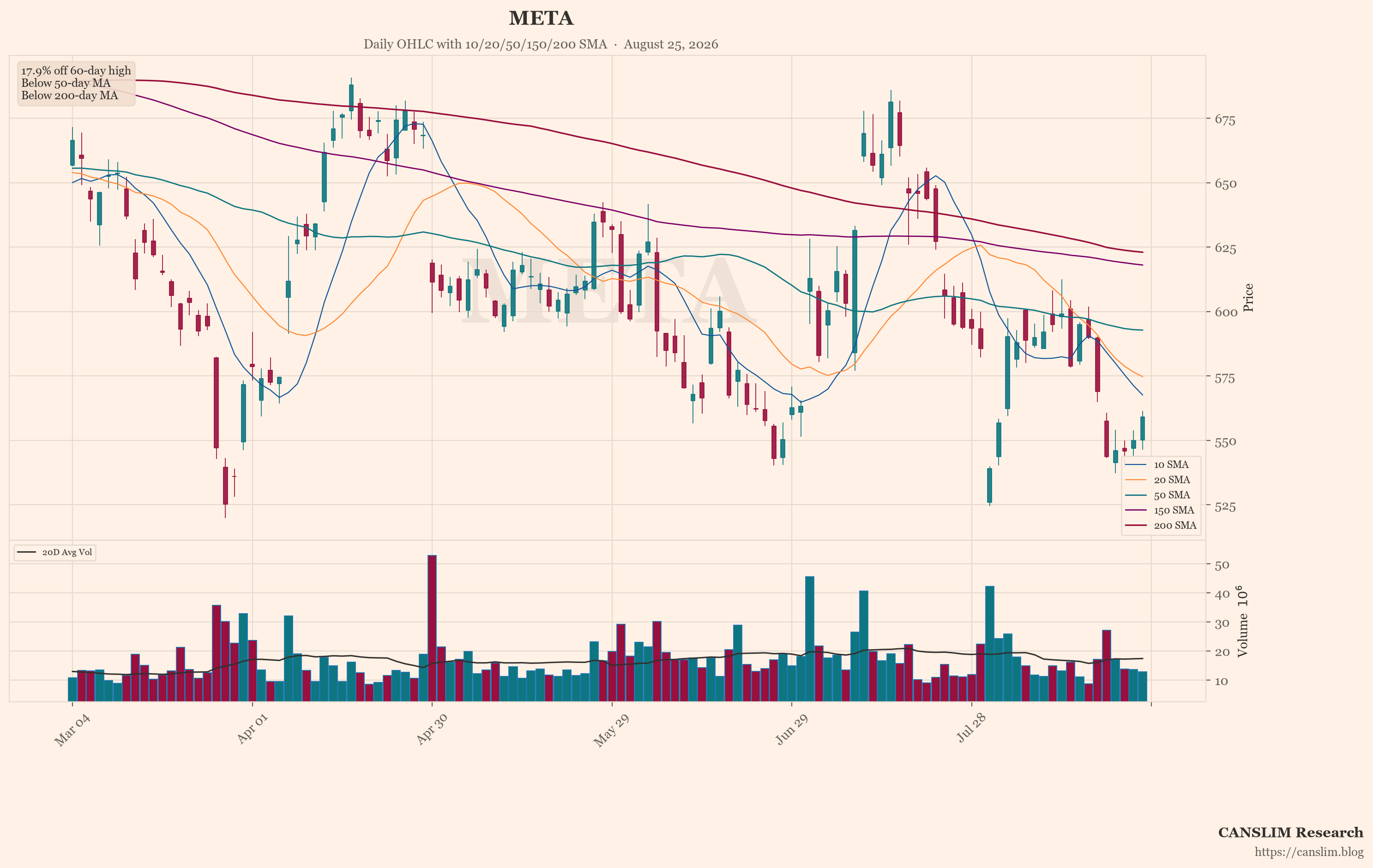
Severe divergence defines the broader market. META rose 2.10% to 561.11. MSFT gained 1.11%, AMZN added 1.45%, and GOOGL climbed 1.22%. Defensive leader WMT gained 2.69% to 106.49. Meanwhile, TSLA fell 3.68%, ASTS dropped 8.42%, and RKLB lost 5.62%. The featured chart is META, which currently shows the weakest technical pattern. This is notable because META is green on the day. Yet its chart structure lags peers. For growth-stock investors, price action matters more than daily headlines. A weak pattern in a leader suggests distribution beneath the surface. The online crowd discusses META heavily, but the technicals do not support aggressive buying here.
Long-Term Yields Pressure Growth While Old Economy Groups Hold
Long-term rates remain a source of background pressure. The 30-year Treasury yield touched 5.33% this month, a new 19-year high. This stems from $40 trillion in national debt and annual issuance needs exceeding $2 trillion. Gold GLD rose 0.80%, while MSTR gained 2.93%. Higher yields help some old economy groups. Materials and energy usually hold up better when inflation stays sticky. Seeking Alpha notes the economically sensitive materials sector is breaking out. Barron’s highlights three sectors that could outperform if the Fed hikes rates. This rotation away from crowded tech trades into value areas is a classic late-cycle signal. The market is near highs, but the foundation looks more fragile than the index level suggests.
Jackson Hole and the Fed’s Next Move Hold the Key
Jackson Hole and the next inflation print are the catalysts to watch. Warsh is expected to push for a cleaner market signal. Bessent tries to stabilize the bond market. Those two approaches may not line up neatly. If long yields stay elevated, that keeps pressure on growth stocks. It supports energy and materials. It forces investors to reprice how much leverage the AI trade can absorb before it slows. The fear/greed level sits near 32/100, fearful but lacking capitulation-level pain. VIX is repeatedly mocked for being “absurdly low during such an event-packed week.” Fear is concentrated in individual stocks rather than at the index level. Only scattered signs of genuine capitulation exist. Most participants hold through the pain or switch to short-term trades.
The Fragile Foundation Beneath Record Highs
The market’s foundation looks fragile even as indexes hover near records. AI debt issuance at $220 billion is a massive bet on future growth. Chip stocks leading the pullback shows the AI trade is no longer a one-way bet. NVDA breaking down before earnings adds uncertainty. META’s weak technical pattern warns that even green days can hide distribution. The online crowd is exhausted but not broken. They are angry, not bearish. For growth investors, this is a time for selective action. Focus on relative strength in materials and energy. Avoid adding to weak charts like META. Wait for NVDA earnings to reset the narrative. The next few weeks will determine whether this is a healthy pause or the start of a deeper correction.
Sources: market news brief & global social sentiment data. Updated 2026-08-25 06:00 HKT. For educational purposes only — not investment advice.
Discover more from CANSLIM Research
Subscribe to get the latest posts sent to your email.
