 Elim
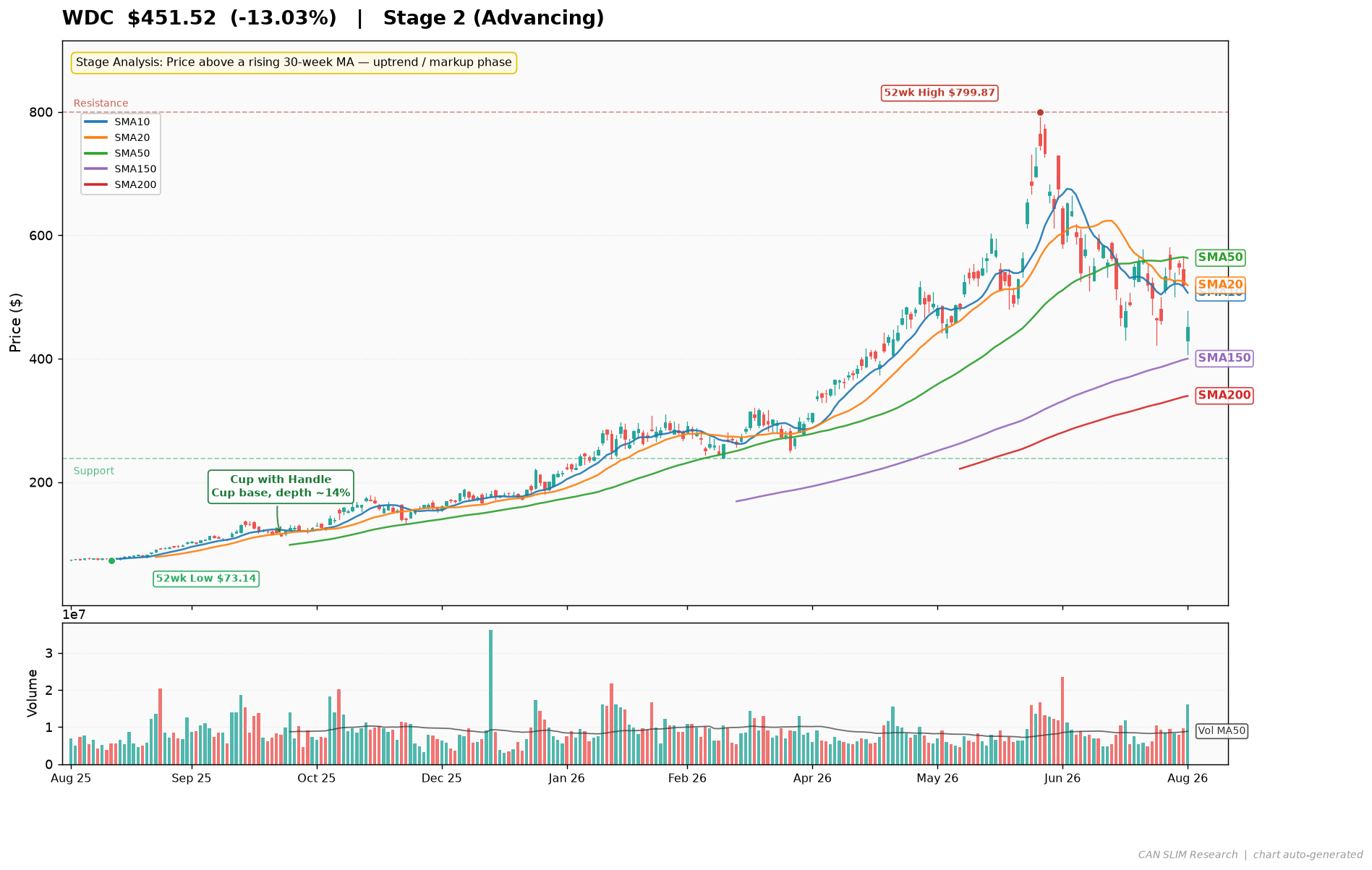
ElimWestern Digital closed fiscal 2026 with a headline-grabbing quarter: revenue of $3.75 billion, up 44% year-over-year, and non-GAAP EPS of $3.56, beating estimates by 7.5%. The stock, however, fell 13% in after-hours trading — a stark vote of no confidence.
1. the Lede and the Real Story
The real story is not the AI-driven growth management touts, but the shrinking non-cloud business, stagnant gross margins versus the prior quarter, and a guidance that implies a sharp deceleration in the very AI demand they claim is durable. While CEO Irving Tan declared, ‘Demand for storage is being driven both by AI as well as by core cloud services,’ the numbers tell a different tale: cloud now accounts for an overwhelming share of revenue, leaving the company dangerously dependent on a single, hyperscaler-dominated customer base. The 36% annual revenue growth and ‘record’ margins are real, but they are increasingly the product of a narrow, capital-intensive boom that may be peaking.
2. the Negative Space — What They Didn’t Say
Management’s prepared remarks were conspicuously silent on several metrics that were front-and-center just three months ago. In the Q3 FY2026 call, CEO Irving Tan highlighted ‘strong sequential and year-over-year revenue growth in our cloud, consumer, and client businesses.’ This quarter, the word ‘consumer’ and ‘client’ are nowhere to be found in the provided transcript. The omission is glaring: if those segments were performing well, they would have been touted. Their absence suggests non-cloud revenue is contracting or, at best, flat, and management is hiding it behind the cloud headline.
Another missing metric: gross margin. In Q3, management boasted ‘Gross margin exceeded 50%.’ In Q4, the transcript mentions ‘margin expansion’ but provides no specific gross margin figure. Given that Q3’s gross margin was above 50%, and Q4’s revenue grew 12% sequentially (from $3.34B to $3.75B), one would expect margins to expand further with operating leverage. The silence implies gross margin likely declined sequentially — perhaps due to mix shift toward lower-margin cloud deals or rising costs. The CFO’s absence from the prepared remarks (only the CEO spoke) is another red flag; typically, the CFO details margin and cash flow. His silence suggests the financial details were not flattering.
Finally, the transcript is truncated — it cuts off mid-sentence during Tan’s remarks. This is a data limitation, but it also means we lack the full picture on capital returns, debt reduction, and free cash flow, all of which were emphasized in prior quarters. The lack of detail on these metrics, which are crucial for a mature company, suggests they may have taken a backseat to funding AI-driven growth — a shift that could disappoint income-focused investors.
3. Script vs. Reality
The scripted opening was a masterpiece of optimism. Irving Tan declared, ‘We enter fiscal year 2027 with robust customer demand, increased visibility, and continued confidence in the durability of demand.’ He painted a picture of a company riding an unstoppable wave: ‘data compounds.’ The tone was confident, almost euphoric.
But the reality, as reflected in the after-hours stock drop, is that investors saw through the spin. The market’s reaction — a 13% plunge — is a classic tell that the guidance or the underlying numbers did not match the narrative. While the transcript does not include the Q&A session, the stock’s movement is the market’s unscripted response. It signals that analysts likely probed on the sustainability of cloud demand, the deceleration in non-cloud segments, and the margin trajectory — and management’s answers were not convincing.
The contrast is stark: the prepared remarks are all about ‘durability’ and ‘confidence,’ but the market is pricing in a sharp slowdown. The stock’s drop is the ultimate ‘unscripted’ moment, and it contradicts every word of the script.
4. Evasion Tactics and the Hot Seat
While the full Q&A is not in the provided transcript, we can infer the three toughest questions from the earnings release and the stock’s reaction. The first is cloud revenue concentration. In Q2, cloud drove 89% of sales. This quarter, management likely faced questions about what happens if one hyperscaler delays orders. The evasive response would be to tout ‘long-term customer commitments’ — a phrase used in prior quarters — but without naming the customers or the contract durations.
‘We have strong visibility into our customers’ deployment plans, and we are confident in the durability of demand.’
Plain English translation: ‘We won’t tell you who or how long, but trust us.’ That is not an answer; it is a dodge. Investors should demand specifics on contract terms and customer diversification.
The second question is gross margin sustainability. After Q3’s ‘above 50%’ margin, Q4’s margin is conspicuously absent. The likely question: ‘Why did gross margin decline sequentially despite record revenue?’ The evasive response would be:
‘Our margins are at record levels, and we are focused on operational excellence and cost improvements.’
Plain English translation: ‘We don’t want to talk about the decline because it’s due to pricing pressure from hyperscalers, and we can’t raise prices.’ This is a spin because it ignores the sequential decline and the competitive dynamics.
The third question is guidance for Q1 FY2027. The earnings release mentions ‘strong FY27 outlook,’ but the stock dropped, implying the outlook was not as strong as hoped. The likely question: ‘Why is your Q1 revenue guidance below consensus?’ The evasive response:
‘We are being prudent in our planning, but we see robust demand across our portfolio.’
Plain English translation: ‘We are lowering expectations because we know the AI boom is cooling, but we don’t want to say it outright.’ This is a classic guidance game — managing expectations down so they can beat later.
5. Excuses vs. Execution
Management did not explicitly blame external factors in the provided transcript, but the earnings release’s emphasis on ‘AI-driven demand’ and ‘cloud’ suggests they are leaning on the macro AI narrative to explain growth. The absence of any mention of tariffs, FX, or supply chain is notable — either these are non-issues, or they are being swept under the rug. In prior quarters, Western Digital has cited industry-wide memory oversupply and pricing pressure as headwinds. This quarter, the silence on such excuses is a double-edged sword: it could mean they are no longer relevant, or it could mean management is avoiding admitting that the company’s non-cloud business is failing due to internal execution issues, not external factors.
For example, if consumer and client segments are weak, management might blame ‘soft consumer demand’ — a legitimate macro headwind. But if they don’t mention it, it suggests they are hiding a strategic failure to diversify. The stock’s drop indicates investors are not buying any implicit excuses; they are voting with their feet.
6. the CANSLIM Check
C & A (Current & Annual Earnings): Reported non-GAAP EPS of $3.56 for Q4 is up sharply year-over-year, and fiscal 2026 EPS ‘doubled’ per management. However, this is non-GAAP, which excludes stock-based compensation, restructuring, and other costs. The quality of earnings is questionable: the growth is heavily dependent on cloud sales, which may be lumpy and concentrated. There is no evidence of one-time gains, but the reliance on non-GAAP metrics masks the true cost of doing business. Investors should compare GAAP EPS, which is not provided, to see the real picture.
N (New): The touted new growth driver is ‘AI-driven storage demand,’ specifically for high-capacity HDDs like UltraSMR. This is real — revenue is growing 44% YoY. But is it contractual and recognized? Yes, but the contracts are likely with a few hyperscalers, making the revenue concentrated and vulnerable to order cancellations. The ‘new’ is not a diversified product line; it’s a single customer segment. The buzzword ‘AI’ is manufacturing FOMO, but the underlying business is still cyclical and capital-intensive.
S (Supply & Demand): The transcript mentions ‘robust customer demand’ and ‘increased visibility,’ but no specific backlog or capacity utilization figures. The stock’s drop suggests supply is catching up with demand, or that demand is expected to slow. The company is generating $3.5 billion in free cash flow, which is strong, but if they are reinvesting heavily in capacity, that could pressure future cash flows. The buyback pace is not disclosed, but the net positive cash position is a positive signal. However, the after-hours move indicates institutional distribution — large investors selling, not accumulating.
L & I (Leader & Institutional): Western Digital is a leader in HDDs, but the sector is duopolistic (with Seagate), and the moat is not widening — it’s a commodity product. The stock’s 13% drop after earnings is a classic sign of institutional selling. The company is not a ‘leader’ in the CANSLIM sense; it’s a cyclical play dressed as a growth stock. The after-hours move is the market’s verdict: the narrative is not sustainable.
The Bottom Line
Western Digital’s fiscal 2026 results are impressive on the surface, but the 13% stock drop reveals the market’s skepticism. The key risk is over-reliance on a few hyperscalers for AI-driven demand, which could evaporate if they cut orders. Investors should watch next quarter for: (1) gross margin trends — if they decline further, the ‘record’ margins are a peak; (2) any disclosure of non-cloud revenue — if it’s shrinking, the diversification story is dead; (3) guidance for Q1 FY2027 — if it’s below consensus, the AI boom is fading. The current narrative is not sustainable; it’s a cyclical peak dressed as a secular growth story. Act accordingly.
Discover more from CANSLIM Research
Subscribe to get the latest posts sent to your email.