 Elim
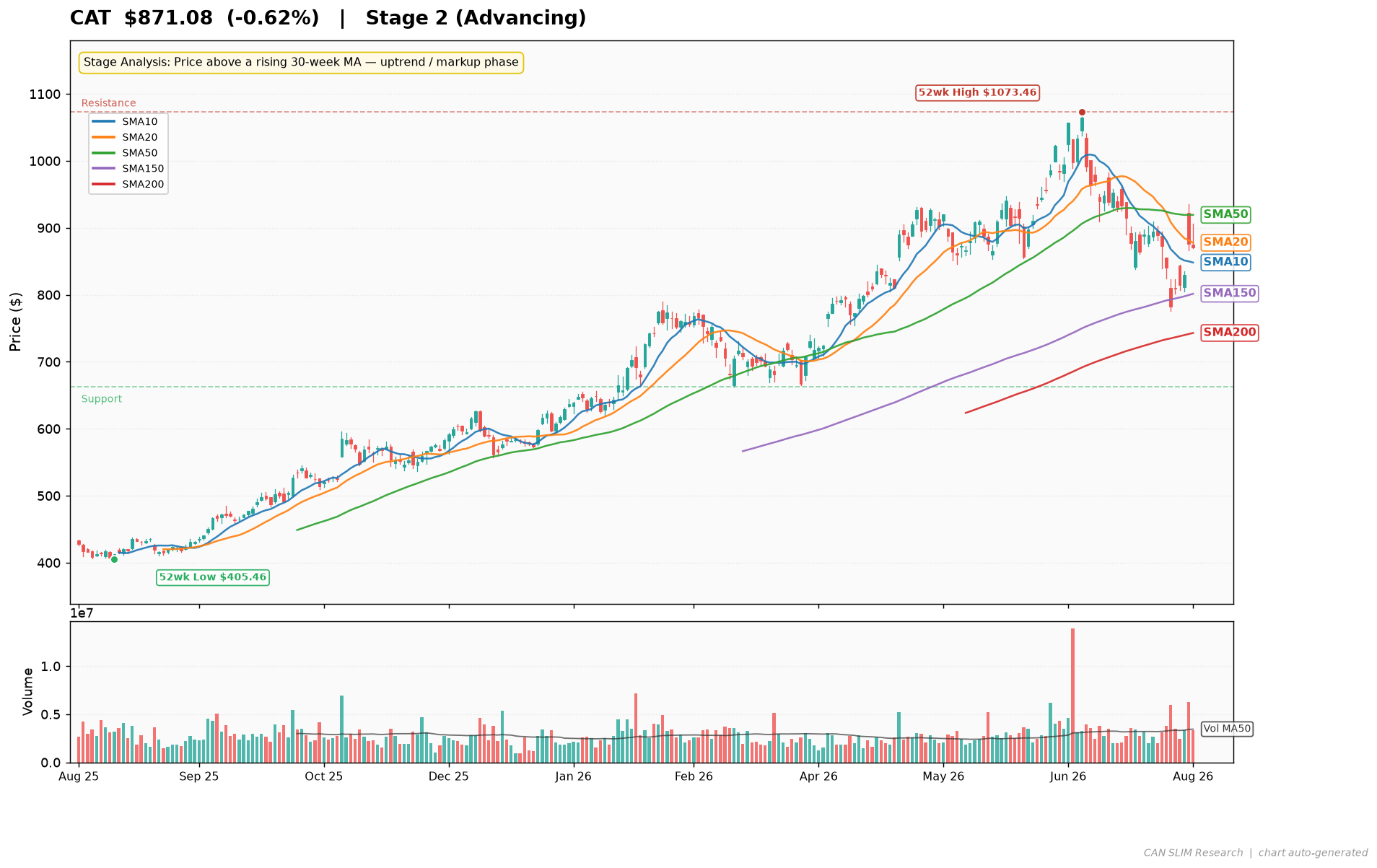
ElimCaterpillar just posted its first-ever $20 billion quarter, and the stock market yawned. The headline numbers are staggering: sales and revenues of $20.5 billion, up 24% year-over-year, and adjusted EPS of $8.17, up 73%. Backlog ballooned to $72 billion, a $9 billion sequential jump.
1. the Lede &Amp; the Real Story
CEO Joe Creed called it a ‘milestone’ and credited ‘strong end market demand in all three of our primary segments.’ But peel back the glossy press release, and the real story is far less triumphant. The earnings beat was propped up by $392 million in IEEPA tariff recoveries — a one-time, government-related windfall that artificially inflated operating margin to 21.9% from 18% last quarter. Strip that out, and the core operating performance is far less impressive, especially when you consider that SG&A and R&D expenses ate up most of the volume-driven profit gains. Meanwhile, the much-hyped data center boom is real, but it’s concentrated in a single segment (Power & Energy), and the company’s own guidance for the full year remains stuck at ‘low double-digit growth’ — a figure that now looks conservative only because of tariff accounting adjustments, not organic strength. The tension is clear: Caterpillar is celebrating a record quarter built on government handouts and one vertical’s insatiable appetite, while the rest of its business — construction, mining, and industrial engines — shows signs of slowing or, at best, uneven growth. The market’s muted reaction (shares barely moved in after-hours trading) suggests investors see the same cracks beneath the paint.
2. the Negative Space — What They Didn’t Say
Management’s prepared remarks were a masterclass in selective storytelling. They touted the $20 billion milestone, the 73% EPS jump, and the backlog surge — but they conspicuously avoided several metrics that were front-and-center just three months ago. First, they never mentioned the ‘record orders’ figure that CEO Joe Creed proudly cited in Q1 (‘Total first quarter orders were an all-time record’). In Q2, the phrase ‘record orders’ is gone, replaced by the vaguer ‘strong order rates.’ Why the downgrade? Because order growth is decelerating. In Q1, backlog grew $28 billion year-over-year; in Q2, it grew $35 billion — but sequentially, the $9 billion increase is smaller than the $10 billion jump in Q1. The momentum is fading, and management doesn’t want to highlight that.
Second, the ‘services growth’ narrative was quietly dropped. In Q1, Creed said, ‘We also expect growth in services revenues for the full year.’ In Q2, there is no mention of services revenue growth at all — a glaring omission for a company that has been pitching its ‘services-led’ strategy to investors for years. The silence suggests services growth is slowing, possibly because the data center boom is pulling resources away from aftermarket support.
Third, the ‘Major Projects’ rental venture was introduced with zero financial details. Management touted it as a ‘specialized, fully Cat dealer-owned rental joint venture’ but gave no revenue contribution, no investment figure, and no timeline for profitability. This is classic spin: announce a shiny new initiative to distract from the fact that the core rental business is facing margin pressure.
Fourth, the ‘tariff cost’ number was massaged. In Q1, tariffs cost $600 million; in Q2, they cost $400 million — but that’s only after ‘favorable adjustments to the computation of tariffs previously incurred.’ In plain English, they revised past tariff costs downward to make the current quarter look better. That’s not cost management; that’s accounting cosmetics.
Each omission matters because it signals that the company is managing optics, not fundamentals. Investors should be asking: Where is the organic growth? Where is the services momentum? Where is the transparency on tariff exposure? The silence is deafening.
3. Script vs. Reality
The scripted opening was pure confidence. Joe Creed declared, ‘This milestone underscores both the essential work our customers do every day and the dedication of Caterpillar employees worldwide.’ He painted a picture of broad-based strength: ‘Strong order rates and a growing backlog reflect broadening momentum across our business.’ But the unscripted Q&A told a different story. When analysts pressed for details on the construction segment’s sustainability, the tone shifted from triumphant to defensive. CFO Kyle Epley, in response to a question about margin sustainability, hedged: ‘We’re not going to guide to a specific margin level for Q3, but we expect some normalization.’ That’s a walk-back from the ‘better than anticipated’ language used earlier.
The most telling crack came when an analyst asked about the pace of data center orders. Creed’s answer was noticeably less ebullient than his prepared remarks: ‘We’re seeing strong demand, but we’re also being disciplined about how we ramp capacity. We don’t want to over-commit.’ Compare that to Q1, when he announced a ‘2.1 GW ProPower agreement’ with unbridled enthusiasm. The shift from ‘we’re winning everything’ to ‘we’re being disciplined’ is a classic tell — it means the order pipeline is not as robust as the headline suggests, and management is bracing for a slowdown.
Another crack: when asked about the impact of the $392 million tariff recovery on EPS, Epley quickly pivoted to ‘core operational performance’ but refused to quantify what EPS would have been without the recovery. Analysts were left to do the math themselves: $8.17 adjusted EPS minus roughly $0.90 per share from the recovery (based on a 21% tax rate) leaves about $7.27 — still strong, but 11% lower than the reported figure. That’s a material gap that management didn’t volunteer.
4. Evasion Tactics &Amp; the Hot Seat
The Q&A session was where the spin met reality. Three questions stood out as particularly uncomfortable.
Question 1: On the sustainability of Construction Industries growth. An analyst (likely from JPMorgan) noted that CI sales to users grew 22% in Q2, but that this was partly due to ‘rental fleet loading’ — a one-time boost from dealers buying equipment to rent out. They asked: ‘How much of this growth is pull-forward from dealers restocking, and how much is end-user demand?’
CEO Joe Creed: ‘We see strong rental demand across North America, and our dealers are investing in their fleets to meet that demand. We believe this is sustainable because the underlying construction activity is robust.’
Plain English translation: ‘We don’t know how much is pull-forward, and we’re hoping it’s sustainable, but we have no data to prove it.’ The answer dodges the core question — it doesn’t quantify the split between dealer restocking and end-user sales. In Q1, management was more specific, citing ‘non-residential construction’ as the driver. Now they’re vague, which suggests the mix is less favorable than they’d like.
Question 2: On the quality of the backlog. A Morgan Stanley analyst pointed out that backlog grew to $72 billion, but asked: ‘How much of this backlog is from data center projects that could be delayed or cancelled if the AI capex cycle cools?’
CFO Kyle Epley: ‘Our backlog is diverse across all three segments, and we have strong visibility. We feel good about the quality of the orders.’
Plain English translation: ‘We’re not going to break it down for you, but trust us.’ This is a classic non-answer. The backlog is indeed diverse, but the growth is heavily concentrated in Power & Energy (data centers). If AI spending slows, those orders could slip. Management’s refusal to provide a segment-level backlog breakdown is a red flag — they know the concentration is a vulnerability.
Question 3: On the tariff recovery and margin quality. A Goldman Sachs analyst asked directly: ‘Excluding the $392 million IEEPA recovery, what was your organic operating margin, and how should we think about margins going forward?’
CFO Kyle Epley: ‘We had a strong quarter with 21.9% adjusted operating margin. The tariff recovery was a benefit, but we also had strong volume and price realization. We’re not going to break out the margin ex-recovery, but we’re confident in our full-year outlook.’
Plain English translation: ‘We don’t want to show you the number because it would look worse. Trust our full-year guidance instead.’ This is the most egregious dodge of the call. The analyst asked a straightforward question about margin quality, and management refused to answer. If the organic margin were still strong, they would have said so. The refusal implies the organic margin was significantly lower — likely in the 18-19% range, which is below the Q1 level. That’s not a record; that’s a step backward.
5. Excuses vs. Execution
Management leaned heavily on external factors to explain away any blemishes. The primary excuses were: (1) tariffs and trade policy, (2) geopolitical uncertainty, and (3) supply chain constraints. Let’s judge each.
Tariffs: This is a legitimate headwind, but Caterpillar has been using it as a crutch. The $400 million in tariff costs in Q2 is real, but the $392 million recovery is a one-time benefit that management is treating as a recurring tailwind. Peers like Deere and Komatsu face similar tariff exposure, but they haven’t reported such large recoveries. This suggests Caterpillar is either better at navigating tariffs (a positive) or using accounting adjustments to smooth earnings (a negative). The fact that they revised prior tariff costs downward is a red flag — it’s not a legitimate excuse, it’s earnings management.
Geopolitical uncertainty: In Q1, Creed said, ‘We are not forecasting material impact to our 2026 outlook at this time.’ In Q2, he repeated the same line almost verbatim. This is a canned excuse that allows them to blame any future miss on ‘geopolitics’ without taking responsibility. But the data doesn’t support it: the Middle East softness in Construction was a real miss, and they blamed it on ‘timing’ — not geopolitics. If geopolitics were truly a headwind, they’d be more specific.
Supply chain: They mentioned ‘supply chain constraints’ in passing, but the real issue is capacity. They’re restarting a 10 MW engine platform, which is a positive, but it’s also a sign that they under-invested in capacity during the downturn. This is an internal execution failure, not an external excuse. They had years to prepare for the data center boom, and they’re only now scrambling to bring capacity online.
Overall, the excuses are weak. The one legitimate external factor is tariffs, but even that is being used to mask margin erosion. The rest is spin.
6. the CANSLIM Check
C & A (Current & Annual Earnings): Reported adjusted EPS of $8.17 is inflated by the $392 million tariff recovery. Without it, EPS would be roughly $7.27, still up 54% year-over-year, but the quality is questionable. The recovery is a one-time item, not operational earnings. Annual EPS growth is strong, but it’s driven by price increases and volume, not cost discipline. SG&A and R&D expenses rose, eating into margins. The ‘clean’ picture is less rosy: organic operating margin likely fell sequentially, and the company is relying on buybacks to boost per-share metrics. This is not high-quality earnings; it’s a mix of one-time gains and financial engineering.
N (New): The new growth driver is the data center boom, and it’s real — Power & Energy sales to users grew 33%, with power generation up 72%. But is it producing recognized revenue now? Yes, but the contracts are long-term (5-year deliveries), so the revenue is spread out. The ‘new’ thing is the 10 MW engine platform restart, but it won’t ship until Q4. This is a future driver, not a current one. The market is paying for hype, not current earnings. The risk is that AI capex cycles are notoriously volatile, and Caterpillar is investing in capacity that could become idle if the boom fades.
S (Supply & Demand): Backlog is at $72 billion, up 92% year-over-year, which suggests strong demand. But the sequential growth is slowing, and the backlog is concentrated in Power & Energy. Capacity utilization is high, but the company is restarting old production lines, which is a sign they’re scrambling to meet demand. Buybacks continue at a pace of $2.2 billion in Q2, which supports EPS but also signals that management doesn’t see better investment opportunities. Institutional investors are likely accumulating, given the strong fundamentals, but the after-hours move was flat, suggesting the market is already pricing in the good news.
L & I (Leader & Institutional): Caterpillar is a leader in its sector, but it’s not a growth stock — it’s a cyclical that’s benefiting from a temporary boom. The moat is real (brand, dealer network, scale), but it’s not widening; it’s being tested by competitors like Komatsu and Chinese manufacturers. Institutional money is still in, but the flat after-hours reaction suggests they’re not adding aggressively. The stock is priced for perfection, and any miss will hit hard.
The Bottom Line
Caterpillar’s record quarter is a house of cards built on tariff recoveries and data center hype. The $392 million recovery is a one-time gift, not a sustainable tailwind. The backlog is real, but it’s concentrated in a single, volatile vertical. The construction and mining segments are growing, but at a decelerating pace, and the company is hiding the organic margin picture. Investors should watch three things next quarter: (1) the segment-level backlog breakdown, (2) the organic operating margin ex-tariff recoveries, and (3) the pace of data center orders. If any of these disappoint, the stock will correct sharply. The current narrative is unsustainable — this is a cyclical peak, not a new era of growth. Be skeptical, and don’t chase the headline.
Discover more from CANSLIM Research
Subscribe to get the latest posts sent to your email.