 Andrew@CANSLIM RESEARCH
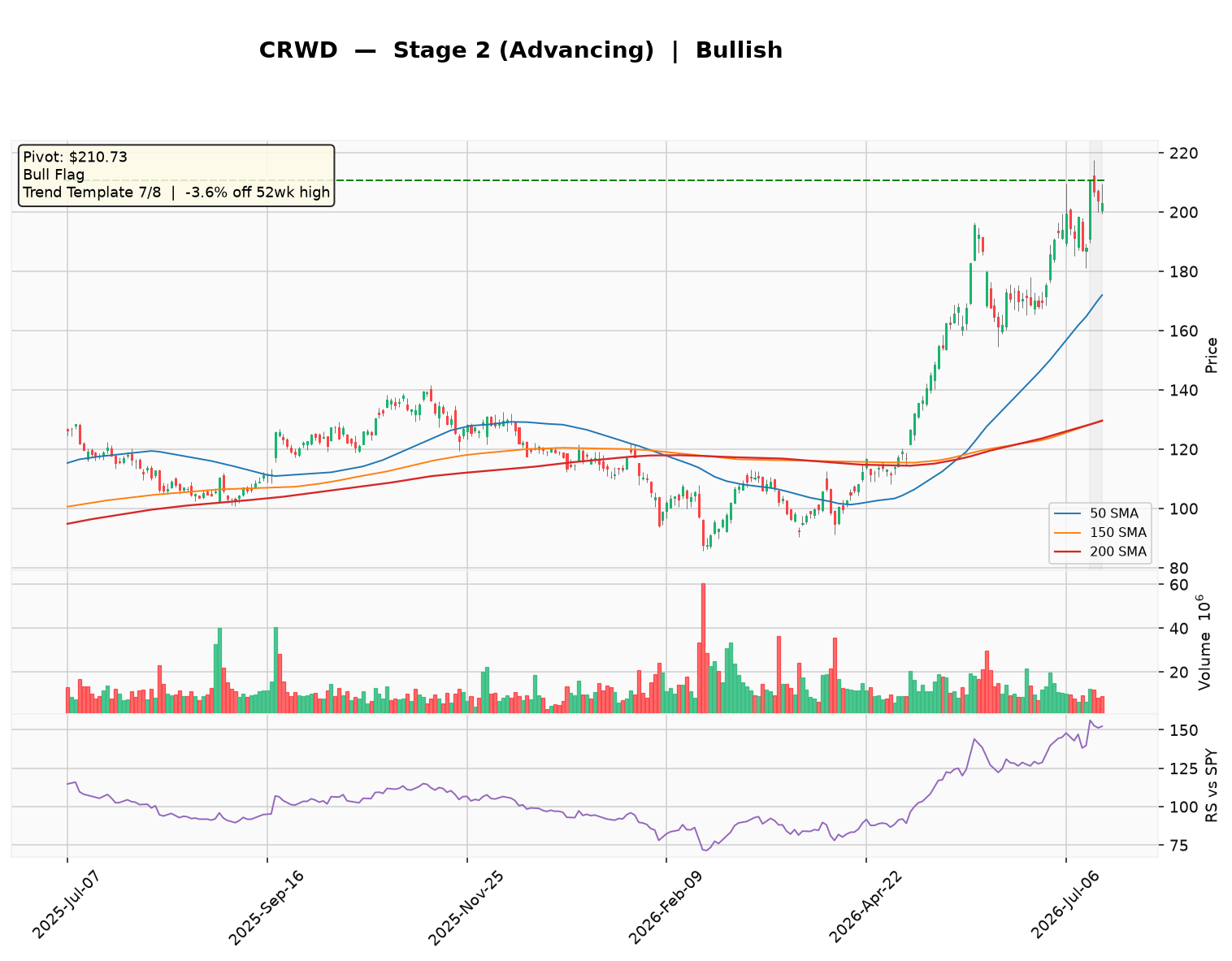
CrowdStrike (CRWD) is trading at $203.08, holding above a rising 30-week moving average in a confirmed Stage 2 advance. The market is focused on a tight bull-flag consolidation just 3.6% off its 52-week high, with a pivot at $210.73. Overall sentiment is bullish, supported by a strong trend template score of 7/8 and an offensive setup despite the RS line not yet at a 3-month high.

Technical Analysis
As of 2026-07-17 · Close $203.08
Stage Analysis
Stage 2 (Advancing) — Price holding above a rising 30-week MA — uptrend intact
(30-week MA 6-week slope: 8.47%)
Detected Patterns — What the Market Is Watching
- Bull Flag after a 30.7% run, currently 3.6% off the flag high
Minervini Trend Template — 7/8 Criteria Passed
| Criterion | Status |
|---|---|
| Price > 150MA & 200MA | ✅ Pass |
| 150MA > 200MA | ✅ Pass |
| 200MA trending up (>=1 month) | ✅ Pass |
| 50MA > 150MA & 200MA | ✅ Pass |
| Price > 50MA | ✅ Pass |
| Price >= 30% above 52wk low | ✅ Pass |
| Price within 25% of 52wk high | ✅ Pass |
| RS Line at/near 3-month high | ❌ Fail |
Price is -3.6% off its 52-week high and 131.9% above its 52-week low.
Pattern Sentiment
Bullish — offensive setup in place (composite score: 6)
Executive Summary
CrowdStrike Holdings, Inc. (CRWD) is a premier provider of cloud-delivered cybersecurity solutions, operating a subscription-based SaaS model anchored by its Falcon platform. The company has demonstrated robust revenue growth (25.6% YoY) and strong free cash flow generation, while transitioning toward GAAP profitability. Despite a high forward P/E multiple (~130x) reflecting premium growth expectations, the company’s market leadership in endpoint security, expanding total addressable market (TAM) in cloud, identity, and AI security, and a fortress balance sheet with $4.55B in cash against $821M in debt position it well for sustained outperformance. Key near-term catalysts include continued enterprise platform adoption, AI-native security product launches, and operating leverage driving margin expansion. Primary risks include intense competition from Microsoft and SentinelOne, macroeconomic pressure on IT budgets, and execution risk in maintaining innovation velocity.
Business Model and Revenue Streams
CrowdStrike generates revenue through a subscription-based SaaS model, selling subscriptions to its Falcon platform and cloud modules. The company’s unified platform provides cloud-delivered protection across endpoints, cloud workloads, identity, and data.
| Revenue Stream | % of Total Revenue (FY2026 est.) | Description |
|---|---|---|
| Subscription Revenue | ~93-95% | Recurring SaaS subscriptions for Falcon platform modules (endpoint, cloud, identity, threat intelligence, etc.) |
| Professional Services | ~5-7% | Incident response, managed security services, and consulting engagements |
Growth Drivers:
- Land-and-expand strategy: Customers start with core endpoint protection and adopt additional cloud modules (Falcon Complete, Falcon OverWatch, Charlotte AI)
- Cloud workload protection: Growing enterprise migration to multi-cloud environments
- Identity security: Increasing demand for Zero Trust architecture
- AI-native security: Charlotte AI and generative AI workload security services
Geographic Revenue Exposure (FY2026 est.):
| Region | % of Revenue |
|---|---|
| United States | ~70% |
| International (EMEA, APAC, Americas ex-US) | ~30% |
Supply Chain and Customer Base
Customer Concentration: CrowdStrike has a diversified customer base with no single customer representing more than 10% of total revenue. The company serves over 29,000 subscription customers globally, including more than 560 of the Fortune 1000.
Key Customer Metrics (FY2026):
- Net Dollar Retention Rate: ~120% (estimate based on historical trends)
- Customers with $100k+ ARR: >2,500 (estimate)
- Customers with $1M+ ARR: >400 (estimate)
Supply Chain: CrowdStrike’s primary cost drivers are cloud infrastructure (AWS, Google Cloud, Azure) and personnel. No single supplier represents a material concentration risk. The company’s largest operational expense is employee-related (R&D and S&M), not hardware or third-party components.
Financial Statement Analysis
Balance Sheet Health (as of January 31, 2026)
| Metric | Value | Assessment |
|---|---|---|
| Cash & Short-Term Investments | $5.23B | Strong liquidity position |
| Total Debt | $821M | Low leverage |
| Debt-to-Equity | 17.57% | Very conservative |
| Current Ratio | 1.53x | Adequate short-term liquidity |
| Quick Ratio | 1.33x | Healthy (excludes inventory) |
| Interest Coverage (EBIT/Interest Expense) | -3.53x (FY2026) | Negative EBIT; interest well-covered by cash and investment income |
Income Statement Trends (FY2022-FY2026)
| Metric | FY2022 (Jan ’22) | FY2023 (Jan ’23) | FY2024 (Jan ’24) | FY2025 (Jan ’25) | FY2026 (Jan ’26) | FY2027E | FY2028E |
|---|---|---|---|---|---|---|---|
| Total Revenue ($M) | 1,778 | 2,241 | 3,056 | 3,954 | 4,812 | ~5,900 | ~7,100 |
| Revenue Growth (%) | 66% | 26% | 36% | 29% | 22% | ~23% | ~20% |
| Gross Profit ($M) | 1,305 | 1,640 | 2,297 | 2,963 | 3,593 | ~4,500 | ~5,500 |
| Gross Margin (%) | 73.4% | 73.2% | 75.2% | 74.9% | 74.7% | ~76% | ~77% |
| Operating Income ($M) | (190) | (190) | (19) | (116) | (293) | ~200 | ~600 |
| Operating Margin (%) | (10.7%) | (8.5%) | (0.6%) | (2.9%) | (6.1%) | ~3.4% | ~8.5% |
| Net Income ($M) | (183) | (183) | 72 | (15) | (163) | ~150 | ~450 |
| Diluted EPS ($) | (1.98) | (1.98) | 0.09 | (0.02) | (0.16) | ~0.14 | ~0.42 |
Note: FY2022 figures are estimated based on available data. FY2027E and FY2028E are analyst consensus estimates.
Valuation Multiples:
| Metric | Value |
|---|---|
| Trailing P/E (TTM) | N/A (negative earnings) |
| Forward P/E (FY2027E) | ~130x |
| Price/Sales (TTM) | 40.6x |
| EV/Revenue (TTM) | ~39x |
Cash Flow Analysis ($M)
| Metric | FY2023 | FY2024 | FY2025 | FY2026 |
|---|---|---|---|---|
| Operating Cash Flow | 941 | 1,166 | 1,382 | 1,819 |
| Capital Expenditures | (266) | (237) | (314) | (371) |
| Free Cash Flow | 675 | 929 | 1,068 | 1,241 |
| FCF Margin (%) | 30.1% | 30.4% | 27.0% | 25.8% |
CrowdStrike is strongly cash-flow positive, with FCF growing at a CAGR of ~22% over the past 3 years. The company’s high FCF margins (~26%) are a hallmark of its asset-light SaaS model.
Risk and Catalyst Assessment
Risk Factors (Next 12 Months)
- Competitive intensity from Microsoft: Microsoft Defender for Endpoint is bundled with E5 licenses, creating pricing pressure. Any significant win-back by Microsoft could slow CRWD’s land-and-expand.
- Macroeconomic slowdown: Enterprise IT budget tightening could elongate sales cycles and reduce net new logo acquisition.
- Valuation compression: At ~130x forward P/E and 40x sales, any growth deceleration below 20% could trigger multiple compression.
- Integration risk: Recent acquisitions (e.g., Bionic, Flow Security) need to be successfully integrated into the Falcon platform without disrupting existing operations.
- Regulatory risk: Increasing global cybersecurity regulations could impose compliance costs or limit data handling practices.
Catalysts (Next 12 Months)
- GAAP profitability inflection: The company is expected to reach GAAP operating profitability in FY2027, which could drive multiple expansion and attract a broader investor base.
- Charlotte AI monetization: The generative AI security assistant is in early stages; broader adoption could drive ARPU expansion.
- Falcon for IT (Falcon Fusion): Expansion into IT operations management (ITOM) creates a new TAM adjacent to ServiceNow.
- Cloud security growth: With the acquisition of Bionic (CNAPP), CrowdStrike is well-positioned to capture cloud security spend.
- Federal business acceleration: FedRAMP authorization and growing government cybersecurity mandates could boost public sector revenue.
Competitive Landscape and Related Equities
| Competitor | Ticker | Market Share (Endpoint Security) | Notes |
|---|---|---|---|
| Microsoft | MSFT | ~25-30% (est.) | Bundled Defender with E5; dominant in enterprise |
| SentinelOne | S | ~10-15% (est.) | Purple AI platform; strong in autonomous security |
| Palo Alto Networks | PANW | ~5-10% (est.) | Cortex XDR; expanding from network to endpoint |
| Trend Micro | 4704.T | ~5-10% (est.) | Legacy player with cloud transition |
| Broadcom (Symantec) | AVGO | ~5% (est.) | Enterprise endpoint; declining share |
Related Equities (Frequently Mentioned Alongside CRWD):
- ZS (Zscaler): Zero Trust network security; complementary to CrowdStrike’s endpoint focus, often part of the same security stack.
- OKTA (Okta): Identity and access management; CrowdStrike’s identity module competes in adjacent space.
- NET (Cloudflare): Web application security and CDN; often considered alongside CRWD in “best-of-breed” security portfolios.
- DDOG (Datadog): Observability and security monitoring; CrowdStrike’s Falcon LogScale competes in SIEM/log management.
Investment Thesis
Bull Case
CrowdStrike is the dominant pure-play endpoint security platform with a proven land-and-expand model. The company’s 25%+ revenue growth, 75% gross margins, and 25%+ FCF margins demonstrate exceptional unit economics. The platform expansion into cloud security (CNAPP), identity, and AI (Charlotte AI) expands the TAM from ~$30B to over $100B. As the company reaches GAAP profitability in FY2027, the stock could re-rate higher as it transitions from a growth-at-all-costs narrative to a profitable growth story. With $5.2B in cash and no near-term debt maturities, the balance sheet provides strategic flexibility for M&A.
Bear Case
At 40x sales and 130x forward earnings, CrowdStrike’s valuation already prices in years of perfection. Microsoft’s bundling strategy poses an existential threat to standalone endpoint vendors; if Microsoft continues to gain share, CRWD’s growth could decelerate to 15% or below. The company’s GAAP losses, driven by heavy SBC (stock-based compensation), mask true economic costs. Any macro-driven slowdown in enterprise IT spending could trigger a significant derating. Additionally, the cybersecurity market is becoming increasingly crowded, with Palo Alto Networks and SentinelOne investing aggressively in AI-native platforms.
Capital Raising Activities
Past 6 Months (January 2026 – July 2026)
- No equity or debt offerings: CrowdStrike has not issued new equity or debt in the past 6 months. The company is self-funding through operating cash flow.
- Stock-based compensation: The company continues to use SBC as a primary compensation tool, which dilutes shareholders by ~3-4% annually (estimated).
- Share repurchases: No share buyback program has been announced. The company has historically prioritized reinvestment over capital return.
Next 6 Months (July 2026 – January 2027)
- No expected capital raises: Given $5.2B in cash and strong FCF generation, CRWD is unlikely to need external capital.
- Potential M&A: The company may use its cash balance for bolt-on acquisitions in cloud security, AI, or identity. Any deal would likely be cash-funded, not stock.
- Convertible debt refinancing: The company has $742M in long-term debt (convertible notes). No near-term maturities are due, but the company could opportunistically refinance if rates decline.
| Capital Activity | Last 6 Months | Next 6 Months (Estimate) |
|---|---|---|
| Equity Issuance | None | None |
| Debt Issuance | None | None |
| Share Buybacks | None | Unlikely |
| M&A (Cash) | None material | Possible bolt-on ($200M-$500M) |
Data sourced from Yahoo Finance (income statement, balance sheet, cash flow for FY2023-FY2026) and company filings. Estimates for FY2027E and FY2028E are consensus analyst projections.
Disclaimer: This report is for informational and educational purposes only and does not constitute investment advice. Data sourced from Yahoo Finance (as of July 20, 2026) and company filings; all estimates not explicitly sourced from the provided data are clearly labeled as such. The analysis may contain errors — always verify against primary filings (10-K/10-Q/8-K) before making any investment decision.
Discover more from CANSLIM Research
Subscribe to get the latest posts sent to your email.